Showing posts with label Finns. Show all posts

Thursday, April 10, 2014

Amelia


Amelia and her first lamb Barrett

Amelia and her twins Cady and Caden
 
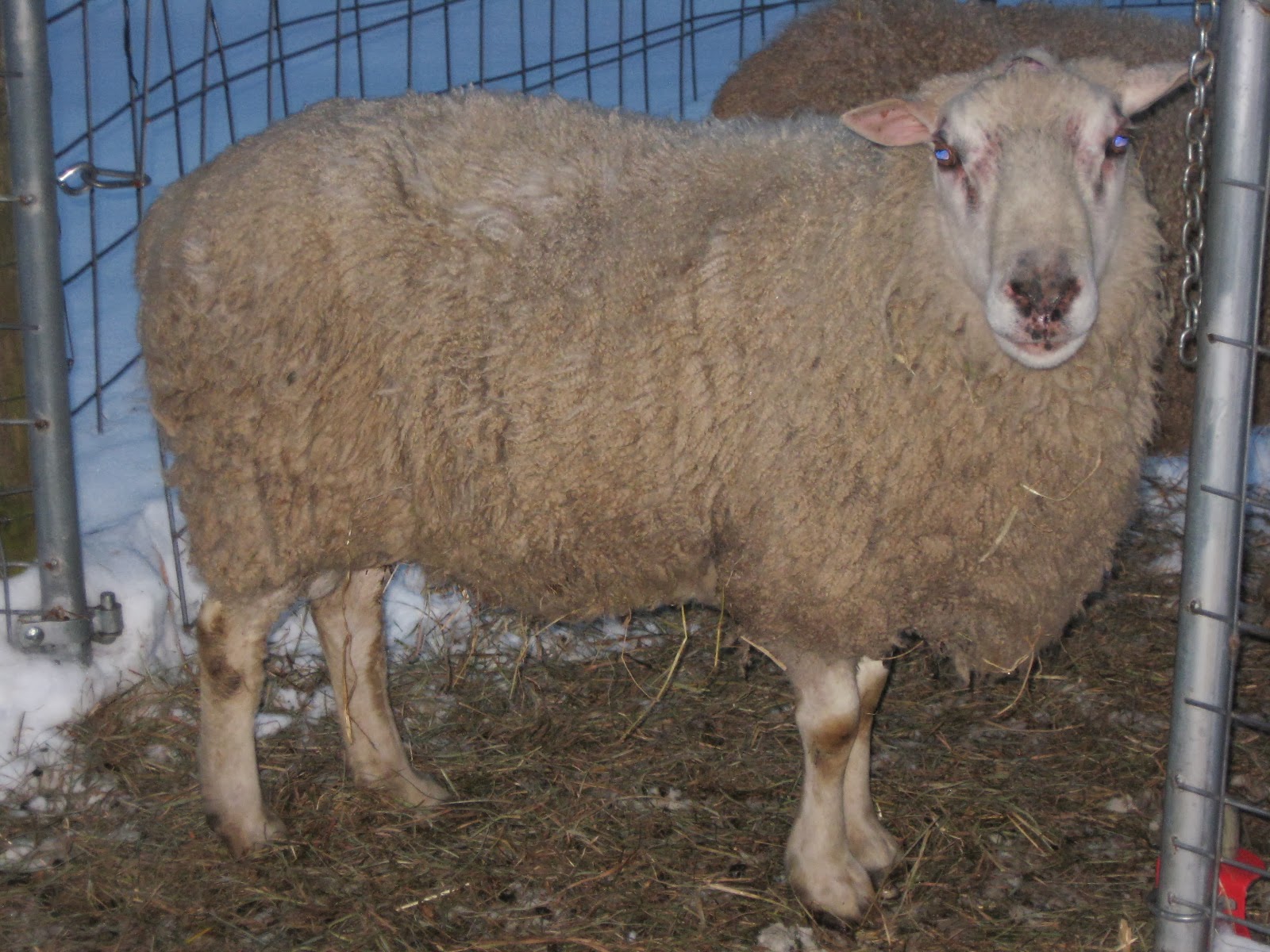
 Amelia is taking it easy these days. Getting up mainly to eat, and then returning to her comfy spot to lie down and chew her cud.

I moved her and a companion - Lana - into their new digs for the next few weeks, so that come lambing time Amelia will have ample shelter from wind and rain and a good chance at keeping her lambs warm should I not be there when they arrive.

Amelia is a black Finnsheep, born in March of 2008. Often a black sheep looks brown, but they are indeed black which is very evident once the fleece is removed and you can see past the weathered tips of the wool locks.

Somewhere back in her lineage there was a brown ancestor, but I don't expect that color to manifest through her as it is a recessive gene and only likely to manifest if a brown ewe is bred to a brown ram.

Amelia carries for spotting which is a fun pattern in sheep. I hope for spotted lambs this year from her, but since the sire of the lambs is white, and its unknown if he carries for spotting himself, we'll see when the lambs arrive. White is dominant in sheep, and often over - rides the other colors, and even if the lambs are white it doesn't rule out the possibility that they themselves carry for spotting.

At six years old, Amelia has had 1/2/2/3/4  or a single lamb for her first lambing, twins the second time, triplets the third and quads the fourth.  In six years, she's had 12 lambs which isn't alot for a Finn ewe and an average of 2 lambs per year.

Lana, her companion at the moment, is 8 this year and came to me as a mature ewe having lambed before. She has had 3/4/3/3/2  and I know she had triplets the year prior to my purchasing her. I'm not sure what she had before that, but what I do know is that she's had 18 lambs at least.

At this time I have four daughters and a son from Amelia. All of her daughters will lamb this year, and it will be fun to see what traits get passed on. Amelias' oldest daughter is Caden who has lambed twice with 2/5. That is a good start. Seven lambs in two years is an average of 3.5 lambs per lambing, and that is a decent rate.

Having a Finn ewe that has a singleton is not the norm, though it is possible with first time dams. Most have twins and some have triplets and up for their first lambing.

Trying to predict how many lambs a ewe will have is tricky, but a fun time for me. It is complicated when they are in full wool, rather than shorn. And it depends on whether the lambs will be above average size or below at birth.
Based on how Amelia looks at the moment and knowing that she consistently has large lambs I suspect she will triplet this year unless for some reason she has little lambs.  What is certain is that anything is possible!


Regards,
Kathryn

Tuesday, April 8, 2014

6 Days Left

Quiet here.

Yesterday was a dreary, cold, day with "wintry mix" type weather. Freezing rain was on the menu. Everything BUT warm and sunny. Sigh.

Mud prevails, and the sheep look awful, wet and bedraggled at this point. I can't wait to shear them as soon as it warms up.

Amelia is spending more time being quiet, which is expected. I will move her into her jug over the weekend. Then I will watch her like a hawk for signs of labor. The weather forecast is for warm and sunny days, and fairly warm - 40 or so - nights. I'll have the lamb coats ready.

Grass is coming up and the girls are practically eating it as it is still pushing through the earth. I understand that though. They cannot wait to taste the succulent shoots. Its been a long winter for everyone.

This will be the year of severe flock reduction. With 20 bred ewes and the potential for 40-60 lambs, I will be interested in selling all of the lambs and 10 of the ewes. I will also be parting with a number of rams as well.

 We are back to the consideration of selling meat from the farm. Still need to work out some details though.

If you are interested in purchasing Finnsheep or freezer lamb, feel free to contact us. We are happy to answer questions.

Regards,
Kathryn

Frankie - Amelias' boy from 2013.  Offered for sale as a yearling.


Saturday, April 5, 2014

Single digits - 9 days left for Amelia

So much to do and so little time.
With the cool temps prevailing and the ever present possibility of freezing temps and snow, I cannot yet shear the sheep, though both me and them are more than ready.
 
Once this rain has passed I will crutch Amelia and Caden, removing the wool from around their udders allowing for the lambs to have better access and less chance of inadvertently nursing on wool tags. Then as soon as it warms up and stays warm, I'll shear the flock. Until then, I'll shear as needed prior to lambing, one at a time.
 
The best shelter for lambing that we have has been used all winter by our flock of Rouen ducks, so I will ban them from it and set about cleaning it, and re bedding with nice, deep and dry straw for Amelia and the lambs to snuggle down in and stay warm.
 
The general rule for lambing is, as many lambs as the ewe has, she should stay that amount of days in a separate pen, known as a "jug" away from gen pop ( general population ) to allow the lambs and her to bond and acclimate. So, two lambs, two days, three lambs - three days and so on.
Some ewes don't need so much time, knowing perfectly well who their lambs are, and where they are at all times. New, first timers can benefit from the ability to focus solely on their new babies without the dynamic of other sheep.
It's not uncommon for a pregnant ewe to steal a lamb from a new mom, taking over and treating it as her own. No real harm is done but the pregnant ewe has no milk and so isn't a good choice for the lamb. We've had this happen once, and were able to sort things out quickly and without mishap.
 
The grass is already shooting up and tender blades are everywhere if still rather short. By the time Amelia's lambs are ready for general population, it's very likely we'll have some pasture and the rich, lush nutrients so important to the recuperation of the ewe and growth of the lamb will be plentiful.
 
Thank God we have said Good Bye to winter.  As life quickens all around, regeneration and restoration are under way, bringing fertility and abundance of plants, animals and  birds.
We're processing the maple sap now and I expect to hear the peepers and the wood frogs very soon.
Can't wait!
Regards,
Kathryn
Waiting patiently.


Friday, January 31, 2014

January 31, 2014

Corrigan - one of our 2014 sires
Wow, 1/12 of 2014 gone already! 


What is left isn't so bad....really.

February which is a "short" month ( I am so heartened by this! ) and then we are into March.

So, only four weeks until we begin the upside of the year with visions of warmth, lush new growth and lambs. I can handle that.
Caden - bred ewe for sale
 

We are still holding our own and the flock seems well despite the prolonged brutal cold. I'm thankful they are woolly creatures with enough protection from the cold and wind to be okay during these spells. Currently we are in a warm spell, with the daytime high being 20 and nighttime being around 10. Way better than the -20 night time temps we were having. And thankfully its a dry cold which makes even the brutal -degree temps bearable.

Oddly this winter we have two occurrences that remind me of Spring. One is a healthy flock of Blue Jays. The make a noise that I have associated with Spring since I was very young and due to their presence this winter, I  am constantly within earshot of their familiar song. Warmer days are coming!

The other is more sunshine than usual for this time of year. Not so much snowfall, and so the skies are clear and bright blue which is uplifting and greatly appreciated. Combined, both things help to keep me from falling into that winter time, cabin fever, blah mood.

I am impressed each year that the ewes are able to sustain themselves, grow beautiful wool and produce lambs even through these harsh conditions, and solely on a grass/hay based diet. They are well designed to do what they do, and the Finnsheep bring personality, affection and entertainment to the mix as well.

This year's lambing season has me a bit cautious with 21 ewes bred, the most I've had in my shepherding career. Six of these will be first timers. With that many ewes due to lamb, its quite possible that someone in the flock will have sextuplets or even septuplets and I expect the usual triplets which are fairly standard.

Last year, 11 bred ewes gave me 30 live lambs, so I would expect to have ....gulp...between 50 and 60 this year! I also don't have any plans to leave the property for about three months! 

First lambs of 2014 are due on April 15, which means I usually start getting excited about two weeks before and start trying to guess how many lambs the ewe will have. I have only 8 weeks until April 1. By then, maple sugaring time will have come and gone, and there should be definite signs of warmer, greener surroundings!

And of course there will be shearing time, with this year giving me 31 Finn fleeces to remove, skirt, pick and generally enjoy! Wool is the reason for having these beasties after all. At least it was the original reason. Now I just enjoy them on every level!

So, taking this all into account, my time for weaving and spinning with any regularity will be short now. So, I'm signing off to get as much textile production done as I can over the remaining few weeks of winter. 

Regards,
Kathryn


Sunday, January 19, 2014

Line Breeding


Sunday morning here. Slow start and then the momentum gradually picks up.

Coffee and plenty of it.

As I sip my cuppa, I think about the coming lambs and remember back to my early shepherding days when breeding stock was a new challenge.

With Finnsheep being small in number in the USA, getting unrelated breeding stock to develop separate bloodlines isn't easy, and the importation of semen from Finland was prohibited.

Initially I was adamant that my breeding animals be unrelated but quickly I learned that within five generations almost all of  the animals are related, with few exceptions.

Due to the efforts of a few Finnsheep breeders with decades of experience, there are a few lines that are completely unrelated but not many.

So I began to get familiar with terms like: inbreeding, crossbreeding, line breeding and out breeding.

Also the term " closed flock. "

Once I determined that I had the number of animals I wanted, I decided to close the flock, meaning no new animals from different sources would be allowed. This minimizes the potential for disease and gives me less to worry about.

But, what can come of it eventually, is that your stock becomes more and more closely related until such time as you do decide to open the flock and bring in new blood. Then it is time to quarantine the new animal until you can be assured it poses no threat to the established flock.

In the meanwhile, various breeding's result in bloodlines with common characteristics among the related animals and these can be good or bad or both.

In the animals with a number of very strong traits, a desire to preserve and perpetuate those traits leads a shepherd to begin considering line breeding, or a deliberate pairing of animals with common ancestors, in the hope of enhancing the existing traits or at a minimum passing good traits on to more progeny.

Unfortunately, this can also result in enhancing of negative traits as well.

Understanding this, and having a willingness to deal with the negatives through culling, leaving only the stronger and better animals, is the intention of line breeding.

Under these circumstances it is desirable to breed related animals, and not such a scary proposition as I once believed.

In the end, what you intend to do with your flock, is what determines whether line breeding is a choice or not.
Lambs destined for the meat market are terminal early on in their lives so negative characteristics aren't going to be passed on. Line breeding isn't a problem there.

Breeding stock, especially that to be sold to other shepherds, needs to be top quality so culling of less than superior animals is a must.

If pets and fiber animals with a fleece worthy enough to keep, then some negative traits aren't an issue as long as the negative animal isn't used for breeding or exhibits traits known to impact the animals quality of life.

This info isn't intended to be a guide or tutorial, simply food for thought and one of the issues I've learned about as my shepherding experience has unfolded over time.

I'd encourage anyone who is interested to educate themselves on line breeding.

This is an interesting explanation
:
http://www.critterhaven.biz/info/articles/1_ram.htm

Regards,
Kathryn

Saturday, January 4, 2014

January Happenings

https://www.etsy.com/shop/oldschoolhandwovens?ref=si_shop
The big news for January is that we have re-opened our Etsy Shop known as oldschoolhandwovens.

Listings will be added slowly but steadily as I interject the shop tasks with the rest of the goings on here. Please be patient with me. Any questions about goods or services, please ask, don't be shy!

On another note, the sheep have come through the bitter weather well, to my relief.

Our newest shelter, the larger hoop house with the brown cover is proving to exceed my expectations.

Unlike previous hoop house shelters, this one, designed by my DH, utilizes aluminum piping bent and welded for extra strength against the snow loads and high winds. Its tall enough for me to walk around in which is a huge plus as walking hunched over in a half crouch really isn't fun or conducive to taking care of bedding etc.

 The size of the structure makes it easier for me to work in, accommodates more sheep, and will allow for the cleaning it out in the spring to be much more readily accomplished. All this and I can still reach up from the inside to slap the roof and knock the snow off without aid of a tool to assist. All good. Kudos to DH for doing a great job!

Having considered how much I like this new building I've concluded the only element missing is a way to close both ends.
 For the most part the sheep should have the choice of entering or leaving, but there are times when closing them in securely is necessary and as yet, we haven't devised a method to do so, though I have a plan to create swinging gates.
These will most likely be constructed from cattle panels cut in two sections. When added to the end of the structure, they will swing inward to open and keep them out of the way until such time as it is appropriate to close them. Then they will swing outward, coming together in the middle where they will be secured. Easy!

Next year I'll have another just like it and then for all intents, I will be set on critter housing.

One thing about farm life that is certain - the more skills you have and the more things you can do yourself, the better off you will be. Everything from vet skills to growing and preserving food are vital. Thank God we followed our interests early in our lives, as quirky as they seemed to friends and family, because its those skills we now rely on.  It is funny how in hindsight we were preparing for this lifestyle even without truly realizing it.

Now if we could only bale our own hay!

Regards,
Kathryn


Wednesday, December 11, 2013

December 11, 2013

Bygone Days
December 11, 2013 here.

Snow on the ground, cold temps, clear air and weather that changes moment to moment no kidding.

The sheep are all settled in their winter enclosures.
Breeding has begun and indeed, is almost completed.

Spring 2014 will see new lambs again and I will be midwife to the ewes, a role I don't mind because it almost invariably has me playing a supporting part, one which allows me to simply watch.

Lambing time is stressful to say the least, much of which I bring on myself, admittedly since I can't stand the excitement of waiting for the lambs and feel I have to check on the ewes hourly. This ritual starts a good two weeks before I know they are due in the hope that I can stare the ewes into labor somehow. To date, no such luck!

There is little else that compares with seeing a long awaited and hoped for lamb, newly out of the
wrapper ( ewe ) shocked into this world and valiantly struggling to breathe, stand and nurse. Those first few moments and hours are tense for me and each year I vow not to put myself through it again, only to anticipate the next breeding season as soon as the current one has seen the last new lamb to be born for the year.

Now, winter is the time for weaving, spinning and gearing up for Spring. Around here this is often a phenomenon we have come to term " mud season".  Rather than a nice gradual warming up and flourishing of plants and creatures, we have snow which melts all at once causing flooding and making the ground obnoxiously muddy. This gives way to "April Showers" and our Spring is curtailed due to rain, mud and sometimes ice that makes the idea of starting spring farm chores a joke. Yet, we somehow survive and get things done anyway, and have come to anticipate this cycle.

So for now, I'll skirt fleeces, spin fiber and weave up as much as I can get done because its only 126 days until the first lambs are due! But...........who's counting?

Monday, November 4, 2013

November 4, 2013

 Breeding season is upon us.

Finnsheep can breed all year long, but many people, myself included, prefer spring lambs, so breeding is timed for fall.  November breeding will bring April lambs. Depending on the year, maybe a bit late for Easter, but otherwise in time for the lush new grass and a good time for the lambs and ewes who are lactating.

A common practice with sheep is to "flush" them prior to breeding. This means they are offered the best possible nutrition in grain, supplements and hay that is available. The theory is that nature will recognize a well fed and well nourished animal and conditions will encourage multiple lambs because of it.

In some towns throughout the U.S and one on Long Island that I have first hand knowledge of, the name FLUSHING MEADOWS crops up, and even Queens has a borough known as FLUSHING, though the part about the meadow is absent, perhaps having been dropped over the years.

This refers to an area once designated for the purpose of putting animals out on pasture, flushing them with the nutrients available on the new grass. Who knew? And how interesting to envision Long Island and Queens as the once rural, agricultural areas we know them to have been.

Finnsheep however, are able to have litters of as many as 7 lambs at once, with litters of four and five fairly common. Due to this I personally do not flush the ewes prior to putting them with the ram.

Last year we had 30 lambs from 11 ewes. One singleton, two sets of twins, one set of quintuplets and one set of quadruplets, all the rest were triplets.

The single lamb was born to a first time dam.


Of the lambs offered for sale are two remaining ewe lambs that are from a quintuplet litter.

These lambs were sired by Ben. Caden is the dam.   Cadens' dam gave quadruplets this year. 

This was Cadens' second lambing, having produced twins last year. The lineage is one proven for large framed, prolific progeny with outstanding maternalism, hand spinning fleeces and docile temperaments. 

No flushing necessary!

Regards,
Kathryn