Showing posts with label fiber. Show all posts

Tuesday, April 15, 2014

20 Hours Later

I checked on the lambs and Amelia off and on all day, and they seemed fine.


The weather forecast was for rain, so I made sure that the shelter was fortified, and around 7 p.m. gave one last check and headed in for the night.

Within a half hour a hellacious downpour complete with high winds hit and wreaked havoc for about 15 minutes. It was the closest thing to a tornado I've seen, and I was glad to see it pass.

I can attest to the fact that here on our little mountain, the weather is turbulent to say the least. I've seen drops in temperatures as much as 50 degrees in 12 hours or less, as well as rises of the same amount, snow, ice, sun, wind,hail, freezing rain, calm,sun and snow again all in a matter of an hour, and then the cycle repeated itself. I would not be the least surprised to see snow in July here one day.

This morning's feed/water/ check-in revealed three wide awake and active lambs, and their dam seemed to be fine as well. Momentarily. I thought about letting them out but the ground is wet and rain is immanent and I didn't want to risk it just yet. They are cozy and dry so I'll leave well enough alone for the time being.

Sadly, tonight the temps will drop to 20 or lower and snow is on the menu. I'm debating lamb coats as the temps won't go about 35 during the day and will stay low for the next three nights before climbing up again.
Currently I'm leaning away from the coats for a variety of reasons but we'll see as the day unfolds .

The next ewe due to lamb is Caden on the 21st. She also looks like triplets this year and I hope to shear her before the blessed event. Demi will be close on her heels, followed by the others in succession over a period of weeks.

As much as I love lambs, lambing can be exhausting.

More pics this evening.

Regards,
Kathryn

Monday, April 14, 2014

Amelia - Haircut

 Yesterday was gorgeous, up in the 60's.

Everyone enjoyed the sunshine, but were hot with the fleeces on.

I finally couldn't stand watching Amelia anymore and used the hand blades to shear her. She was much more comfortable afterwards.

Lana wanted to be shorn too, but daylight was fading and I only got a small portion done around her neck. I'll try to finish her today.

Problem is...tomorrow night will be rainy and down in the 20's. Not a good temp for sheep with no wool. That is why I used the hand blades vs. the electric shears which would have cut closer and faster.
Amelia will still have enough wool and lanolin to help protect her against wet and cold. And of course they have the little run in shed which is deeply bedded for them to burrow down in.

I expect Amelia to have her lambs on Friday. After removing her fleece, I thought I'd have a better chance at predicting how many lambs, and I always waffle, but I still think triplets.
Could just be twins though. Either way I'll be happy.

More than how many, I'm looking to see if they are colored or white. While I hope for spots, I'm betting on white. Again, we'll see.

With a hefty appetite, and a friend for company, Amelia is doing well, feeling more comfortable and just soaking up the milder weather.

What to do with her fleece??  Oh the possibilities and its the first one of 2014, too!

I hope the weather forecast is wrong about those 20 degree nighttime temps. I really want to shear these sheeple soon.

Regards,
Kathryn


Saturday, April 5, 2014

Single digits - 9 days left for Amelia

So much to do and so little time.
With the cool temps prevailing and the ever present possibility of freezing temps and snow, I cannot yet shear the sheep, though both me and them are more than ready.
 
Once this rain has passed I will crutch Amelia and Caden, removing the wool from around their udders allowing for the lambs to have better access and less chance of inadvertently nursing on wool tags. Then as soon as it warms up and stays warm, I'll shear the flock. Until then, I'll shear as needed prior to lambing, one at a time.
 
The best shelter for lambing that we have has been used all winter by our flock of Rouen ducks, so I will ban them from it and set about cleaning it, and re bedding with nice, deep and dry straw for Amelia and the lambs to snuggle down in and stay warm.
 
The general rule for lambing is, as many lambs as the ewe has, she should stay that amount of days in a separate pen, known as a "jug" away from gen pop ( general population ) to allow the lambs and her to bond and acclimate. So, two lambs, two days, three lambs - three days and so on.
Some ewes don't need so much time, knowing perfectly well who their lambs are, and where they are at all times. New, first timers can benefit from the ability to focus solely on their new babies without the dynamic of other sheep.
It's not uncommon for a pregnant ewe to steal a lamb from a new mom, taking over and treating it as her own. No real harm is done but the pregnant ewe has no milk and so isn't a good choice for the lamb. We've had this happen once, and were able to sort things out quickly and without mishap.
 
The grass is already shooting up and tender blades are everywhere if still rather short. By the time Amelia's lambs are ready for general population, it's very likely we'll have some pasture and the rich, lush nutrients so important to the recuperation of the ewe and growth of the lamb will be plentiful.
 
Thank God we have said Good Bye to winter.  As life quickens all around, regeneration and restoration are under way, bringing fertility and abundance of plants, animals and  birds.
We're processing the maple sap now and I expect to hear the peepers and the wood frogs very soon.
Can't wait!
Regards,
Kathryn
Waiting patiently.


Friday, April 4, 2014

Amelia - 10 days left to lambing time.

 Today as I walked out to greet the girls, they were all at the hay feeder, but came running when they saw me. Amelia however, had been laying down. The best she could do was get up. She was content to stay put while the others checked out the prospect of food rations.

Yesterday was a pleasant enough day, weather wise. Sunny, but cool enough still to be comfortable working outdoors.

Today is going to rain. Not something I look forward to because of the mud and generally yuckiness of a mess it makes, nor the flooding in the streams and brook, but 'tis the season of April showers and such, so what must be must be.


Amelia has been bred to Corrigan this year, and I am curious to see what we get in terms of colors from her lambs. The last two years she was bred to Panda, a spotted ram, and she produced spotted lambs both times. Corrigan is white but I suspect he carries for spotting, and this breeding is a test to see whether we might get spots from him.
Amelia herself is black. When bred previously to Corrigans' father Clef, she gave white lambs each time. Clef is white, but I don't think he carries the spotting gene, Corrigan on the other hand, has one solitary spot, so that would suggest he does carry the gene. We will see in about 10 days!
Shortly after Amelia has her lambs, her daughter Caden will lamb. Caden gave us five lambs last year. Four white and a black. It doesn't appear to me that either Amelia or Caden will have as many this year. I'm guessing triplets for both. 
Amelia with last years' lambs. Annie is curious and looks on.
 
 
Corrigan

Let's keep fingers crossed that the weather gets warm and stays that way long enough for the new lambs to get acclimated. Makes life soooo much easier :-)
 
Regards,
Kathryn 


Saturday, March 22, 2014

March 22, 2014

I love those faces!
 
Grey - trying to figure out what I'm up to and hoping it is more grain.
As the days grow longer and warmer, the girls are getting rounder and rounder.
 It's just a matter of time now.
 
The first lambs are due on April 15th, and I'm getting a bit more observant of the ewes in general and Amelia in particular, the dam who is due to lamb first this year. 
 
 She is fairly large as usual, though she still has three weeks left.
 
She  always has big lambs and last year had four.
 
With all the fleece on it's hard to tell but I don't think it will be four this year.
 I'd be happy with twins, but triplets are more likely.
She was bred to a different ram, one who himself is all white but for one lone spot on his neck.
 
To test and see if he carries the spotting gene, I decided to breed him to Amelia who is confirmed to carry spotting. We'll see what comes in terms of color but I'm expecting white and black depending on how many lambs she has. If I get a nicely spotted ewe lamb, that would be great!
 
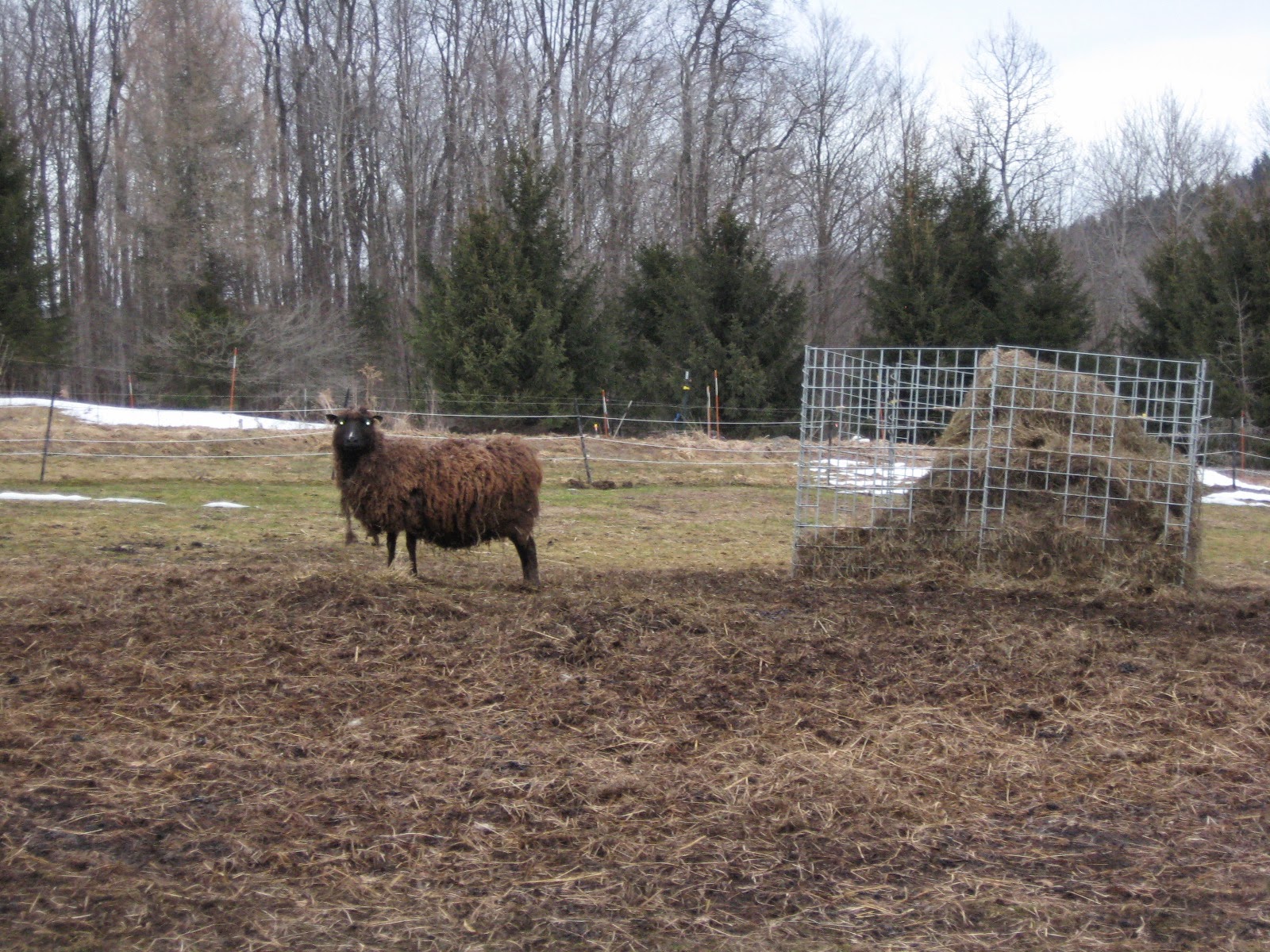
This year we've chosen to feed the girls second cut round bales all winter, using a Premier hay feeder which has greatly reduced any waste.
The down side to this is that they stick their heads into the feeder, rubbing away any wool on their necks. You can see this in the pictures.
 
The up side is.I don't have to worry about shearing their neck and throats this year. That is always a tricky and nervous task because I worry about cutting their throats, but so far, not a problem, and definitely won't be an issue this year.
 
While the ewes have access to hay 24/7 and now are getting grain supplements, I found it curious that several of them seem to be constantly poking in the snow. Sure that they had plenty of drinking water I shrugged and forgot about it.
Last night as I was taking these photos I realized that Amelia had located a stem or two of GRASS! and was digging through the snow much like the deer do, to reach it. God Bless her.  One of the pics shows Amelia in the foreground scoping out that pitiful little bit of grass. You can see how wide she is. Won't be long now for lambs and grass. The girls will be happy.
 
Regards,
Kathryn


Amelia ferreting out the grass under the snow.


Hoping for more grain.
 

Friday, January 31, 2014

January 31, 2014

Corrigan - one of our 2014 sires
Wow, 1/12 of 2014 gone already! 


What is left isn't so bad....really.

February which is a "short" month ( I am so heartened by this! ) and then we are into March.

So, only four weeks until we begin the upside of the year with visions of warmth, lush new growth and lambs. I can handle that.
Caden - bred ewe for sale
 

We are still holding our own and the flock seems well despite the prolonged brutal cold. I'm thankful they are woolly creatures with enough protection from the cold and wind to be okay during these spells. Currently we are in a warm spell, with the daytime high being 20 and nighttime being around 10. Way better than the -20 night time temps we were having. And thankfully its a dry cold which makes even the brutal -degree temps bearable.

Oddly this winter we have two occurrences that remind me of Spring. One is a healthy flock of Blue Jays. The make a noise that I have associated with Spring since I was very young and due to their presence this winter, I  am constantly within earshot of their familiar song. Warmer days are coming!

The other is more sunshine than usual for this time of year. Not so much snowfall, and so the skies are clear and bright blue which is uplifting and greatly appreciated. Combined, both things help to keep me from falling into that winter time, cabin fever, blah mood.

I am impressed each year that the ewes are able to sustain themselves, grow beautiful wool and produce lambs even through these harsh conditions, and solely on a grass/hay based diet. They are well designed to do what they do, and the Finnsheep bring personality, affection and entertainment to the mix as well.

This year's lambing season has me a bit cautious with 21 ewes bred, the most I've had in my shepherding career. Six of these will be first timers. With that many ewes due to lamb, its quite possible that someone in the flock will have sextuplets or even septuplets and I expect the usual triplets which are fairly standard.

Last year, 11 bred ewes gave me 30 live lambs, so I would expect to have ....gulp...between 50 and 60 this year! I also don't have any plans to leave the property for about three months! 

First lambs of 2014 are due on April 15, which means I usually start getting excited about two weeks before and start trying to guess how many lambs the ewe will have. I have only 8 weeks until April 1. By then, maple sugaring time will have come and gone, and there should be definite signs of warmer, greener surroundings!

And of course there will be shearing time, with this year giving me 31 Finn fleeces to remove, skirt, pick and generally enjoy! Wool is the reason for having these beasties after all. At least it was the original reason. Now I just enjoy them on every level!

So, taking this all into account, my time for weaving and spinning with any regularity will be short now. So, I'm signing off to get as much textile production done as I can over the remaining few weeks of winter. 

Regards,
Kathryn


Wednesday, January 22, 2014

January 22, 2014 There are days..........

Horse Drawn Mower Waiting for Spring
There are days in the life of a shepherd that are beyond glorious, when all is well with the world and you know that God is in control.

Then there are the other days.

Don't get me wrong, nothing catastrophic has happened, no lost livestock or any unexpected problems to deal with. The flock is well even though the temp this morning was -13, and we are well.

It is just that in the middle of these long, dark, cold, overcast weeks of winter, I find myself slowly feeling discouraged.

I like winter as a rule, as long as I know the critters are handling it well, I don't mind the twice a day feeding/ checking up on animals and chores, and surprisingly I've come to realize that without those forced outings in all weather, I'd have missed some pretty amazing sights, sounds and moments that you cannot recapture.

Often, looking outside from the warmth of the cottage, its easy to dread stepping out, but most of the time I find once I am outside that it really is quite nice and end up staying outside doing more than I had originally intended because of it.

What I've observed personally is that the doldrums of winter are relieved not by warmer temps or less snow, but simply by sunshine. My spirits are enlivened again and my energy renewed by sunshine.

I don't miss the heat of summer, in fact I dread that more than the cold because it is impossible to escape it and the bulk of the work has to be done at this time. But the sunshine is always a welcome sight coming over the treetops lighting up the day.

The good news is, January will be behind us in 9 days. February in 28 after that. Then comes March and no matter what wacky weather it holds, I know we're on the upswing and the days will get longer, the sun will shine more, and eventually the greenery will return along with bouncing lambs, freshly shorn fleeces and all the warmth I can stand!

So for now, I occupy myself with spinning, weaving, making herbal salves and creams, shoveling and staying warm along with the usual routine chores.

And daydreaming - 83 more days until lambs!

Regards,
Kathryn


Sunday, January 19, 2014

Line Breeding


Sunday morning here. Slow start and then the momentum gradually picks up.

Coffee and plenty of it.

As I sip my cuppa, I think about the coming lambs and remember back to my early shepherding days when breeding stock was a new challenge.

With Finnsheep being small in number in the USA, getting unrelated breeding stock to develop separate bloodlines isn't easy, and the importation of semen from Finland was prohibited.

Initially I was adamant that my breeding animals be unrelated but quickly I learned that within five generations almost all of  the animals are related, with few exceptions.

Due to the efforts of a few Finnsheep breeders with decades of experience, there are a few lines that are completely unrelated but not many.

So I began to get familiar with terms like: inbreeding, crossbreeding, line breeding and out breeding.

Also the term " closed flock. "

Once I determined that I had the number of animals I wanted, I decided to close the flock, meaning no new animals from different sources would be allowed. This minimizes the potential for disease and gives me less to worry about.

But, what can come of it eventually, is that your stock becomes more and more closely related until such time as you do decide to open the flock and bring in new blood. Then it is time to quarantine the new animal until you can be assured it poses no threat to the established flock.

In the meanwhile, various breeding's result in bloodlines with common characteristics among the related animals and these can be good or bad or both.

In the animals with a number of very strong traits, a desire to preserve and perpetuate those traits leads a shepherd to begin considering line breeding, or a deliberate pairing of animals with common ancestors, in the hope of enhancing the existing traits or at a minimum passing good traits on to more progeny.

Unfortunately, this can also result in enhancing of negative traits as well.

Understanding this, and having a willingness to deal with the negatives through culling, leaving only the stronger and better animals, is the intention of line breeding.

Under these circumstances it is desirable to breed related animals, and not such a scary proposition as I once believed.

In the end, what you intend to do with your flock, is what determines whether line breeding is a choice or not.
Lambs destined for the meat market are terminal early on in their lives so negative characteristics aren't going to be passed on. Line breeding isn't a problem there.

Breeding stock, especially that to be sold to other shepherds, needs to be top quality so culling of less than superior animals is a must.

If pets and fiber animals with a fleece worthy enough to keep, then some negative traits aren't an issue as long as the negative animal isn't used for breeding or exhibits traits known to impact the animals quality of life.

This info isn't intended to be a guide or tutorial, simply food for thought and one of the issues I've learned about as my shepherding experience has unfolded over time.

I'd encourage anyone who is interested to educate themselves on line breeding.

This is an interesting explanation
:
http://www.critterhaven.biz/info/articles/1_ram.htm

Regards,
Kathryn

Friday, December 13, 2013

December 13, 2013

14 degrees here this morning. Dry, clear, cold. Really nice!

The first pic is the winter shelters for the ewes.

Pic #2 is one of the breeding groups. Three ewes and a ram.

Pic #3 is the main ewe flock leaving their Premier round bale feeder to come see me as I take their pic.

Pic #4 is Earls' Brother. Perhaps one of THE friendliest and trusting rams I've ever owned. He is a classic example of those sheep who seek out human interaction and affection. I love him!
 Pic #5 is of Freckles (R) and Andy (L). Both lively, curious and friendly boys. Andy is one of the flock sires this year. Hopefully Freckles will be too.

And last - the Percheron team, Paladin (R) and Dick (L).

Yesterday I dropped off some wool products in town at the whole foods store, and have begun to plan for a website where we can showcase and offer our hand made wool items.

Today I'll be immersed in weaving and spinning after feeding the critters.
 I'm waiting for some fiber to come back from the mill and getting ready to send out more. This time I'll send out more organic wool and some fiber to make wool mattress toppers and comforters. I've been wanting to do that for a long time. I also have a few more pelts to ship.

So, daylight is coming and its time to suit up for the feeding and watering chores before everyone starts calling to me.

Regards,
Kathryn


Thursday, December 12, 2013

Finnsheep Fleece

This blog post will be mostly quite subjective on my part, so you know that going forward.

 I started out raising a mixed flock of sheep with Corriedale, Clun Forest, Border Leicester X and Icelandic sheep. I became familiar with those types of wool, and through shearing sheep for others, also became familiar with a wide range of wool types.

As a wool buyer, I don't turn down any fleeces, because I love them all and find a purpose for each wool type that I take. One of the wonders of wool in the 21st century is that, among other attributes, it is versatile and regardless of the fineness or coarseness, it all has a place in the value added product marketplace.

Finn wool, ranges from animal to animal, from fine and crimpy with a medium staple length, to britchy, straight and course on some animals. Hand spinners in the USA are only now becoming familiar with this lovely, high luster wool. In some places a good, clean fleece, free of any hay chaff, burrs, dirt etc. will bring upwards of $20.00 per pound.

Finnsheep come in a variety of colors and it appears that breeders everywhere are concentrating efforts on understanding and producing consistent colored fleeces. While spots, stripes, and many different patterns and markings are possible, white still remains the best for dyeing. White fleeces also carry high luster giving a sheen to the finsished yarn that rivals mohair. Less true for colored fleeces.

When looking at a Finnsheep for wool quality, its important to check for uniformity in the fleece, from shoulder to tail. Often there is a "britch" wool on the hind legs that becomes course and straight. Many hand spinners will toss this as garbage, some will blend it, others will separate it, mix with similar, and use it for rugs. It all depends on what you want your final product to be.

One sure way to know the wool quality of your animals is to send a sample of the fleece to Yocum-McColl who will test it and send back a full report. Often this report is surprising, contrasting with the subjective analysis that results from touching, feeling and seeing the wool.

A fine Finn fleece would be one of 26 micron count, which is, according to Yocum-McColl, the equivalent of Merino wool.

A point to remember is that as a sheep ages, their wool tends to become more coarse. Most of us are aware that a lambs fleece is very, very soft and will be the softest of any fleece the sheep will have in the future.

Wool is a sustainable, renewable and earth friendly product. Sheep grow new wool each year, and depending on the breed, may give two fleeces/ year though most are shorn only once annually, and this in the early Spring prior to lambing.

Wool is coated with lanolin which the sheep produces through numerous glands on its skin. The lanolin content differs according to breed, with some having little lanolin, others having so much that simply handling the fleece covers your hands with it. This is usually referred to as "grease" and wool that is raw, not having been yet washed, is called "grease wool." Back in the day, wool was spun raw with the lanolin still on it and this gave rise to the term, "spinning in the grease."

There is some mixed info on whether or not leaving the lanolin on the yarn as it is spun will afford any water repellent qualities to the finished product. If I were to guess I would think that as long as the garment or textile isn't ever washed that degree of water repellence will remain, but once exposed to wash, will be removed. Just my guess.

I have spun in the grease myself, and enjoy handling wool with the higher degree of lanolin. When skirting raw fleeces with high lanolin content the lanolin will give the feel of a much softer fiber than truly exists, and this can be misleading. Once that wool is washed the true coarser nature is obvious.

Finn wool has a soft, almost silky feel to it that is quite noticeable in the finished yarn. This makes it a good wool for items that come in contact with one's skin where softness is appreciated.

Finn fleeces average somewhere around 6 - 8 pounds in my flock. Having shorn sheep that yield 12 pound fleeces, this doesn't seem like a lot per animal, but in a flock of 30 animals its 180 - 240 lbs of wool, which needs to be skirted, picked, washed, carded and spun. Plenty!

Finn fleece is pleasant spun raw, or from processed rovings, and it felts nicely making it a versatile wool for most fiber artists.

Check out these links for further info:

http://www.finnsheep.org/colors-markings-guide/


Excellent pictures and explanations:
http://www.internationalfinnsheepregistry.org/finn-wool.html


http://www.ymccoll.com/


To the right is Finn Ram, Clef with long staple, high luster wool. This sheen is readily apparent in yarn spun from his fleeces.

Wednesday, December 11, 2013

December 11, 2013

Bygone Days
December 11, 2013 here.

Snow on the ground, cold temps, clear air and weather that changes moment to moment no kidding.

The sheep are all settled in their winter enclosures.
Breeding has begun and indeed, is almost completed.

Spring 2014 will see new lambs again and I will be midwife to the ewes, a role I don't mind because it almost invariably has me playing a supporting part, one which allows me to simply watch.

Lambing time is stressful to say the least, much of which I bring on myself, admittedly since I can't stand the excitement of waiting for the lambs and feel I have to check on the ewes hourly. This ritual starts a good two weeks before I know they are due in the hope that I can stare the ewes into labor somehow. To date, no such luck!

There is little else that compares with seeing a long awaited and hoped for lamb, newly out of the
wrapper ( ewe ) shocked into this world and valiantly struggling to breathe, stand and nurse. Those first few moments and hours are tense for me and each year I vow not to put myself through it again, only to anticipate the next breeding season as soon as the current one has seen the last new lamb to be born for the year.

Now, winter is the time for weaving, spinning and gearing up for Spring. Around here this is often a phenomenon we have come to term " mud season".  Rather than a nice gradual warming up and flourishing of plants and creatures, we have snow which melts all at once causing flooding and making the ground obnoxiously muddy. This gives way to "April Showers" and our Spring is curtailed due to rain, mud and sometimes ice that makes the idea of starting spring farm chores a joke. Yet, we somehow survive and get things done anyway, and have come to anticipate this cycle.

So for now, I'll skirt fleeces, spin fiber and weave up as much as I can get done because its only 126 days until the first lambs are due! But...........who's counting?

Tuesday, November 19, 2013

Tuesday, November 19, 2013

Today dawns blustery, snowy and cold. It is the wind that brings the element of brutality to the climate. Without a doubt you understand immediately the life or death balance any mammal will face without adequate protection from the wind combined with the freezing temps.

Oddly enough, the ducks are happily paddling away on the stream which they will do all winter regardless of wind, cold, snow. They do very well on the water all year long.

Tomorrow will be an interesting day here on the farm as I am receiving three yearling ewes into the flock. These ewes were bred and born here, leaving to join another flock last winter. The flock has been disbanded and I was given the option of taking the yearlings back, so I agreed and tomorrow they arrive.

As far as I know now, that will be the end of any new animals joining our flock this year.

We are still offering three high quality ram lambs for sale, as well as two mature rams with proven breeding records.

In terms of ewes, I will be selecting replacements for some of the girls who are moving into older age. This will be hard to do because the breeding records for them have been superlative.

The three yearling ewes are all colored ranging from solid black ( which I love ) to HST ( head, socks, tail all white ) to piebald.

My intention is to expose the ewe flock to the rams at Thanksgiving which still gives me time to finalize the goals I'm creating.  I mull over the breeding pairs scrutinizing the pros and cons with an eye to eliminating as many cons as I can while instilling as many pros as I can. Then we will watch as nature takes its course, and wait.

In the beginning I am full of enthusiasm at the prospects but eventually this subsides as the day-to-day tasks overtake me, and for a few blessed weeks I forget the girls are bred but then......about six weeks from lambing time I start with renewed excitement. I think its a combination of knowing that winter is almost done, spring is almost on us, and imagining the lambs when they are born.

I watch the ewes like a hawk, checking on them every few hours and sometimes just sitting with them in the pasture for several hours at a time. This is therapeutic for me and seems to be okay with them too.

Despite my best efforts to be present for all lambing, I have a few girls who prefer to wait and lamb in secret, presenting me with freshly born, still wet lambs to help dry and monitor. 

Some ewes are seasoned dams and know what to do without any assistance from me, while the new mothers are sometimes a bit shell shocked and need some direction as they sort out their lambs, the feeding routine and all of the sensations they are bombarded with at lambing time.

This year the plan is to lamb in mid to late April, a full 8 weeks ahead of last years schedule, and I have a back up strategy for meat as well.

All things considered here it is a wonderful life albeit one where tough decisions have to be made to preserve the well being of the flock in general.

This has been a real learning year for this shepherd, bittersweet in many ways, but 2014 lies ahead and hope springs eternal!

Regards,
Kathryn
Ram lambs from 2012
 

Monday, November 18, 2013

Monday, November 18, 2013

Alpaca Blanket in Progress
Wow!

We are on the downhill slide to year's end and it doesn't seem possible!

What an incredible year in so many ways!

We started the 2013 year with only 10 of the umpteen sheep we cared for, having boarded the ewe flock out with a fellow shepherd in exchange for some of the ewe lambs.

Leaving us with only 10 Finn ram lambs, we had no idea at the time of this decision what events would unfold to make that the best decision ever.

For the most part, it was an intuitive nagging at me that urged me to seek an arrangement for the overwintering of the flock last year. While I thought the possibility of a nasty winter was the motivation for the decision, in reality and quite unexpectedly DH sustained an injury at work that made it difficult to care for the few animals remaining here over the winter. Who knew? But what a God send to not have to worry about the girls.

The little ram lambs did fabulously and provided a much needed distraction from all things droll.

Spring saw the ewes reinstalled on their home pastures and awaiting June lambs, and by the first of July the flock had expanded from a mere 21 to 61. Gotta love those Finns and their multiple births!

Lambing went well, with girls holding off while I made a quick trip overnight, and all in all it was a good lambing season.

This past two weeks has been tough as I've re-evaluated the numbers and made decisions about letting certain animals go, but I am feeling optimistic and at peace with those decisions having learned a great deal about life this week especially.

Breeding will commence in earnest Thanksgiving Day which is close at hand as I write.

The looms have been busy and I have fallen into a creative modality in weaving saddle blankets for the time being.

Regards,
Kathryn


Finished wool saddle blanket.


Saturday, November 16, 2013

Saturday - Opening Day for Hunting

 November 16, 2013

Opening Day!

Its a beautiful cool, clear and sunny morning here for opening day of the 2013 hunting season.

We live in an excellent area for all types of wild life and deer are abundant so we hear and see quite a few hunters throughout the season.

Many of the small and not-so-small camps are bustling with activity and the traffic up and down our otherwise quite road, explodes.

Like most people, we have company - an old friend
and hunting buddy of the D.H.

As it happens, he's also a duck carver of many decades.

These past few years he's expanded into other
creatures and this year we were gifted with a very
unique and unusual carving of our beloved pet
Finn ram - Earl.

To say the carving looks like Earl is an understatement.


We are thrilled with the unexpected gift and honored to give it a place on our wall. How cool is that?
 
Over the last few days I've been preparing to finish off some textiles I've been working on.
The pictures are of a saddle blanket, a rug and a rug made solely from rovings. I'm still working on a throw blanket even as I prepare the loom for another saddle blanket. This one will be from Alpaca.
 
The rugs and saddle blanket are not yet finished, though the weaving is done. Remaining is the hemming and fulling and final touch with a steam iron, but in my impatience I went ahead and posted the photos knowing they aren't exactly the best. Can't help myself ! :-)
 
We are now down about 26 sheep from our original total this summer of 61.
While I feel I've culled, sold and parted with everyone I could afford to, we are still a bit on the heavy side as winter eases its way in.
 
As sorry as I am to see any leave as I love them all, I feel confident that those remaining are the beginning of a new core group that will advance the flock over time.
 
I've learned quite a few lessons from all of this selling of sheep.
 
1) Really, don't keep a ram longer than 2  years
 
2) Fiber being the priority for me, I see value in every sheep because it simply has wool. It is just as easy to have top quality sheep with excellent fleeces as it is to have lesser. Go for top quality.
 
3) Make up your mind from the beginning that sheep die, and be okay with orchestrating that when the time comes. As shepherds, we are both the midwives and the grim reaper when the need arises.
 
4) Because my role as shepherd is primarily one of care giver, it is understandably hard to STOP caring when the time comes to part with any animal. Be patient with yourself as you learn to do this.
 
At any rate, life moves on, things are good, hope abounds and we look to the future about five months from now, while we take the winter to hope, envision and expect new life in due course.
 
God is good!
Regards,
Kathryn


Wednesday, November 13, 2013

Premier Round Bale Feeder

Finnsheep Ewes
Now that summer pastures have gone dormant and snow is on the ground, we've started feeding hay.

We've been feeding a combination of round bales to the horses and square bales to the sheep because the square bales are small enough for me to handle without the need for equipment to move them.

While square bales are easier for me to handle, round bales are more economical. Our hay supplier does both so we have access according to what we want and need to feed.

In the past we have opted for round bales for the sheep, both with a traditional round bale feeder and just plopping them on the ground. Either way there seemed to be a good deal of waste as the sheep pulled out, trampled and laid down on the hay. Additionally, I found that hay in the wool was problematic too.
On the recommendation of a friend and fellow shepherd, this year we opted to try a round bale feeder from Premier Livestock supply in Iowa.

This feeder consists of square panels with square holes cut into them at two different heights. This allows both lambs and mature sheep access to the hay at the same time. The square panels are easily assembled and you can purchase as many as you think you need to make a small bale feeder or a large bale feeder.
Ours has been in place about four days now, and the difference was seen immediately. There is NO waste of hay with this feeder.  It is wonderful not to see the ground strewn with hay. The lambs can get to and reach the hay while the bigger ewes feed. This eliminates the tendency for someone to wait to eat, assuring that everyone is getting fed, not just the piggy ones.

The downside is that I cannot move the round bales myself but have to rely on D.H. Of itself this isn’t really a bad thing we just need to plan to move the new bale at a certain time.
The final downside is the shipping cost for the feeder. As far as I know the only way to get equipment from Premier is to have it shipped. This can be costly, but having considered this, I believe it is well worth the cost.
Check it out:
http://www.premier1supplies.com/detail.php?prod_id=99

 Regards,

Kathryn


Monday, November 11, 2013

November 11, 2013 Veterns' Day

As a new shepherd one of the things I had to learn was how to care for the flock when things aren't quite right.

Keeping the flock healthy isn't very hard, but when an unusual medical situation crops up unexpectedly, you either handle it yourself, or call your vet.

There are two main reasons to reserve calling the vet, one is distance. Our livestock vet is an hour away, and since they schedule rounds for most days, they aren't  immediately available to drop what they are doing and drive an hour to my farm. This is a consideration before I pick up the phone.

The other is cost. A farm call is $75.00 and this just covers their coming on the property, no treatment. Weighing both of those things against the need is always a consideration.

In the early days of our shepherding, things went well for the most part. The first call for our vet was to draw blood on the sheep for Johnnes and OPP as a matter of routine. Though some people do this themselves and send to an independent lab, I'm squeamish and would rather the vet do it, quickly, efficiently and easily.

This initial visit allowed us to ask questions and meet the vet prior to any emergency that might arise later on. We didn't want our first contact to be a cold call.

Over time our relationship has grown to a point of trust and co-operation and I feel very strongly that our livestock vet truly has the best interest of the animal at heart.

We have an option for saving the on-farm call fee, by transporting the animal to the vets' office, and we've done this on several occasions. Each time it has been for a lamb, so transport was easy as was the office call. This is a good option.

We have also sought advice via phone call, and have requested certain medications via email, which have been mailed out without problems.

We can give injections, treat wounds, administer oral medications, cast limbs, handle some obstetric situations up to this point,  (God I'm not asking to be challenged here :-) ). Our vet has responded to my request for additional knowledge of certain illnesses with detailed emails on how to perform invasive procedures when there is no other option. Not the best solution but if it is that or death, I'd just as soon pull out all the stops and try to save my animal.

This past spring we had a case of what I believe was bloat in which, despite my efforts and a call to the vet, we lost the animal anyway.  Sometimes it happens and you remember that the other side of life is inevitable death for all of us someday.

The highest priority for an animal that is ill in our flock is to reduce the amount of suffering they may be experiencing. Sometimes this means death and its not easy when you have invested much in bringing the animal as far as it has already come.

All in all, for six years now, we've done okay in terms of emergencies and unforeseen complications, having cared for just about 80 sheep in this time period.

What I've learned is to stay humble, watchful and always ready to learn.

Regards,
Kathryn


In Memory of Mary ScholefieldFriend, fellow shepherd and teacher. You taught me so much!
Rest in peace dear friend.

January 19, 1960  - November 12, 2011


Sunday, November 10, 2013

More Lambs for Sale

Available until November 13, 2013. We are happy to accept a deposit to hold your lamb, arrange for board until you can pick it up, and accept Paypal!


Flash
Demi FBA # 26536
Panda FBA # 24239
Flash is a piebald and carries for spotting. He is a triplet with excellent bloodlines and a soft, crimpy fleece.


Demi just prior to lambing triplets 2013


Flash at Five Months


Panda - Sire of Flash
 

Sunday, November 3, 2013

November 3, 2013

Cold and wet here today. Filled all my water receptacles last night so I wouldn't need the hose until the sun can warm it up later in the day.

The critters all seem to be content for the moment.

In an effort to consolidate groups and minimize space requirements I introduced the remaining ram lambs to the two remaining teen aged rams. This went very smoothly and everyone seems quite happy with the arrangement, so I am happy.

Reintroducing adult rams is NOT one of the necessary actions I enjoy, but I do it because I enjoy it far better than watching them back waaaayyyyyyy up and hit each other full force with an unforgettable crack as they connect. I cannot stand to watch it and even less to hear it, so when the time comes to introduce them again, we squeeze them into a tight, tight space for 24 hours or so, from which they emerge a bit more civil towards each other.

Except for the one time this summer when I had a band of rams roaming about free grazing the property. I took a risk and introduced two other rams to them and there was very little interest or posturing to my relief. Absolutely no head butting at all.
But this is breeding time and the boys know it so they are more inclined to show their dominance than they were in mid summer heat with nothing much going on.
For the time being, I'll have two ram groups.

I'm pleased to say that Dallas seems to have taken a liking to little Asa, though Cwen is still out on the subject, but that is okay.
Asa admires Dallas too but seems to be figuring out logistics.  I'm rooting for the little guy but Dallas is going to have to help him I think. Time will tell.

Yesterday was spent procuring materials to fortify the shelters. In a previous post I discussed hoop houses and completely forgot to mention we also use chain link dog kennels as kind of free - standing stalls.
These are enclosed with tarps to make them wind, snow and more or less water, proof. With a nice deep pile of straw frequently added to, everybody seems cozy enough for the winter, even though we don't use a conventional barn.

On another note, we still have some fine breeding stock available for sale.

Two teen aged rams - white - 18 months old

5 ram lambs - all colored - 5 months old

8 ewe lambs - 6 white, two colored - 5 months old.

They will be available until November 10, 2013.

After that we will begin taking deposits on 2014 lambs.


Regards,
Kathryn

Wednesday, October 30, 2013

Octobe 30, 2013

Luca   FBA #  24518


Up and at 'em on this wet, overcast, raw day!

Today will be a big day as we learn from our first experience with the livestock auction house.

We'll be loading up a mix of the ram lambs and teenaged rams and saying goodbye to them today.

This will give us some breathing room, though we expect to take another load in two weeks; then we should have the flock down to a manageable size for winter.

Awaiting pick-up are two ewes that will be exposed to our new ram, Asa and sold bred, and two ewe lambs and a ram lamb that will be going to fiber homes, with potential for breeding next year. They will be picked up on Friday.

I am holding back a few of the nicest ( hard call, they are all nice ) ram lambs and all of the ewe lambs in hopes of selling them to individuals before the next auction sale.

Already planning breeding groups, and after six years, the flock is going through some major adjustments this year in terms of replacement ewes, and starting new and separate bloodlines.

I have been reviewing flock goals and specific breeding animals to see if they fit in with those goals, and making adjustments accordingly, but sometimes it hurts my brain.

What I've learned is this...its just as easy to have lovely fiber animals, and companions with outstanding genetics as it is to have lesser quality fiber animals/companions. Not that any going to auction have anything to be ashamed of, they are all quite lovely. But from here on 
with a very critical eye to producing the best of the best, my fiber pets will need to be top quality to stay in the flock.

I look forward to reporting on how it unfolds at the auction house.

Regards,
Kathryn