Showing posts with label felting. Show all posts

Sunday, April 13, 2014

Amelia - Holding

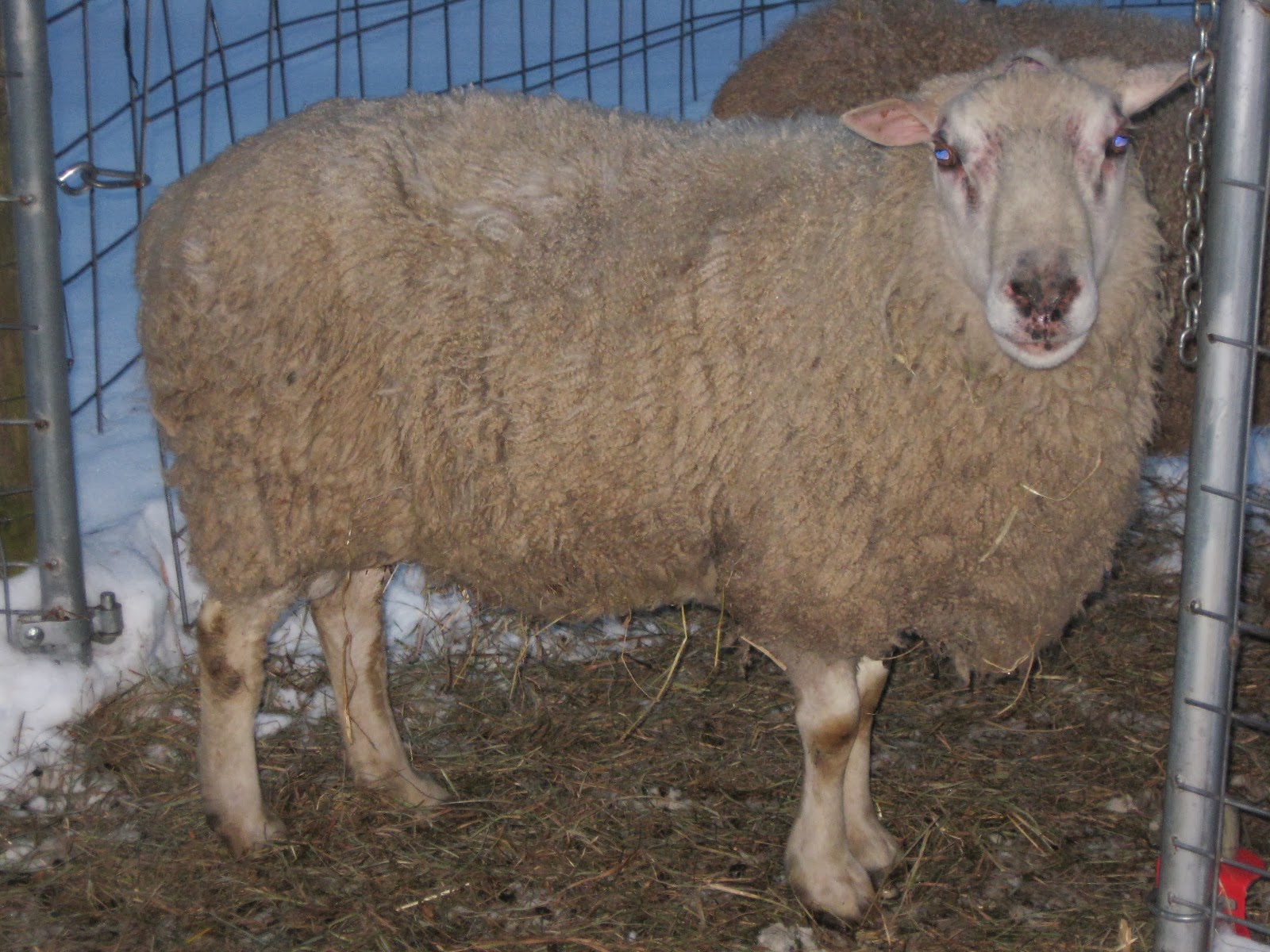
Amelia is enjoying the milder temperatures, her new space and the company of her companion, Lana.

She gets rations twice a day of whole corn/ soy meal / minerals and some choice second cut hay to provide the nutrients both she and the lambs need.

Plenty of water and fresh air are also available and she rests or moves about as she feels inclined.

She is in good health and fine spirits, with a hefty appetite.

Positioned in a small area behind the house it is ideal for me to keep a regular watch for any signs of deviation from the regular behavior. As I go about the chores of housekeeping, weaving, and fiber business, I can look up and quickly get a visual on her. This all but ensures I will know when she is in labor and be present as the lambs are born.

Unless she decides to have them in the middle of the night. Not to jinx myself, but she has had all of her lambs so far, during the daytime, and so hopefully this will be no different.

Can't wait, can't wait!!!   Its like Christmas, birthday, Valentines Day and Anniversary all rolled into one.  Woo Hoo......hope the weather holds :-).

Regards,
Kathryn

Friday, January 31, 2014

January 31, 2014

Corrigan - one of our 2014 sires
Wow, 1/12 of 2014 gone already! 


What is left isn't so bad....really.

February which is a "short" month ( I am so heartened by this! ) and then we are into March.

So, only four weeks until we begin the upside of the year with visions of warmth, lush new growth and lambs. I can handle that.
Caden - bred ewe for sale
 

We are still holding our own and the flock seems well despite the prolonged brutal cold. I'm thankful they are woolly creatures with enough protection from the cold and wind to be okay during these spells. Currently we are in a warm spell, with the daytime high being 20 and nighttime being around 10. Way better than the -20 night time temps we were having. And thankfully its a dry cold which makes even the brutal -degree temps bearable.

Oddly this winter we have two occurrences that remind me of Spring. One is a healthy flock of Blue Jays. The make a noise that I have associated with Spring since I was very young and due to their presence this winter, I  am constantly within earshot of their familiar song. Warmer days are coming!

The other is more sunshine than usual for this time of year. Not so much snowfall, and so the skies are clear and bright blue which is uplifting and greatly appreciated. Combined, both things help to keep me from falling into that winter time, cabin fever, blah mood.

I am impressed each year that the ewes are able to sustain themselves, grow beautiful wool and produce lambs even through these harsh conditions, and solely on a grass/hay based diet. They are well designed to do what they do, and the Finnsheep bring personality, affection and entertainment to the mix as well.

This year's lambing season has me a bit cautious with 21 ewes bred, the most I've had in my shepherding career. Six of these will be first timers. With that many ewes due to lamb, its quite possible that someone in the flock will have sextuplets or even septuplets and I expect the usual triplets which are fairly standard.

Last year, 11 bred ewes gave me 30 live lambs, so I would expect to have ....gulp...between 50 and 60 this year! I also don't have any plans to leave the property for about three months! 

First lambs of 2014 are due on April 15, which means I usually start getting excited about two weeks before and start trying to guess how many lambs the ewe will have. I have only 8 weeks until April 1. By then, maple sugaring time will have come and gone, and there should be definite signs of warmer, greener surroundings!

And of course there will be shearing time, with this year giving me 31 Finn fleeces to remove, skirt, pick and generally enjoy! Wool is the reason for having these beasties after all. At least it was the original reason. Now I just enjoy them on every level!

So, taking this all into account, my time for weaving and spinning with any regularity will be short now. So, I'm signing off to get as much textile production done as I can over the remaining few weeks of winter. 

Regards,
Kathryn


Sunday, January 19, 2014

Line Breeding


Sunday morning here. Slow start and then the momentum gradually picks up.

Coffee and plenty of it.

As I sip my cuppa, I think about the coming lambs and remember back to my early shepherding days when breeding stock was a new challenge.

With Finnsheep being small in number in the USA, getting unrelated breeding stock to develop separate bloodlines isn't easy, and the importation of semen from Finland was prohibited.

Initially I was adamant that my breeding animals be unrelated but quickly I learned that within five generations almost all of  the animals are related, with few exceptions.

Due to the efforts of a few Finnsheep breeders with decades of experience, there are a few lines that are completely unrelated but not many.

So I began to get familiar with terms like: inbreeding, crossbreeding, line breeding and out breeding.

Also the term " closed flock. "

Once I determined that I had the number of animals I wanted, I decided to close the flock, meaning no new animals from different sources would be allowed. This minimizes the potential for disease and gives me less to worry about.

But, what can come of it eventually, is that your stock becomes more and more closely related until such time as you do decide to open the flock and bring in new blood. Then it is time to quarantine the new animal until you can be assured it poses no threat to the established flock.

In the meanwhile, various breeding's result in bloodlines with common characteristics among the related animals and these can be good or bad or both.

In the animals with a number of very strong traits, a desire to preserve and perpetuate those traits leads a shepherd to begin considering line breeding, or a deliberate pairing of animals with common ancestors, in the hope of enhancing the existing traits or at a minimum passing good traits on to more progeny.

Unfortunately, this can also result in enhancing of negative traits as well.

Understanding this, and having a willingness to deal with the negatives through culling, leaving only the stronger and better animals, is the intention of line breeding.

Under these circumstances it is desirable to breed related animals, and not such a scary proposition as I once believed.

In the end, what you intend to do with your flock, is what determines whether line breeding is a choice or not.
Lambs destined for the meat market are terminal early on in their lives so negative characteristics aren't going to be passed on. Line breeding isn't a problem there.

Breeding stock, especially that to be sold to other shepherds, needs to be top quality so culling of less than superior animals is a must.

If pets and fiber animals with a fleece worthy enough to keep, then some negative traits aren't an issue as long as the negative animal isn't used for breeding or exhibits traits known to impact the animals quality of life.

This info isn't intended to be a guide or tutorial, simply food for thought and one of the issues I've learned about as my shepherding experience has unfolded over time.

I'd encourage anyone who is interested to educate themselves on line breeding.

This is an interesting explanation
:
http://www.critterhaven.biz/info/articles/1_ram.htm

Regards,
Kathryn

Saturday, January 11, 2014

January 11, 2014

We've come through the Arctic blast without incident, and now we're braving the ice covered frozen ground saturated with rain. The warnings now are for flooding due to the rain and melting snow.
Mere walking outside is life threatening without proper foot gear, and driving all the more so.

Oddly there have been moments when it feels much like early spring and I think for an instant that it is time to tap trees for sugaring and lambs aren't far off. Then I realize we have another 15 weeks or so of winter and ponder what lies ahead.

Breeding has ceased and the ewes have been paired with three rams this year. A white ram, who carries for color and spotting, a brown ram and a piebald. I am, as ever, excited at the prospects.

The expectation is for at least 40 lambs and closer to 50, so I've made the decision that all ram lambs will be sold to the meat market, unless I have a buyer. While difficult, the revenue will allow for maintaining the fiber and breeding stock.

We are now excepting deposits for reservations on lambs, and also on fleeces. This year there will be 31 fleeces from a variety of different colored sheep, white being predominant and excellent for dyeing.

I'm happy to answer questions and speak with shepherds or potential shepherds regarding the flock and lamb purchases. Feel free to ask.

Also happy to accept deposits on 2014 fleeces as well, contact me for pictures and details.

Regards,
Kathryn