Showing posts with label hand spinning. Show all posts

Tuesday, April 15, 2014

20 Hours Later

I checked on the lambs and Amelia off and on all day, and they seemed fine.


The weather forecast was for rain, so I made sure that the shelter was fortified, and around 7 p.m. gave one last check and headed in for the night.

Within a half hour a hellacious downpour complete with high winds hit and wreaked havoc for about 15 minutes. It was the closest thing to a tornado I've seen, and I was glad to see it pass.

I can attest to the fact that here on our little mountain, the weather is turbulent to say the least. I've seen drops in temperatures as much as 50 degrees in 12 hours or less, as well as rises of the same amount, snow, ice, sun, wind,hail, freezing rain, calm,sun and snow again all in a matter of an hour, and then the cycle repeated itself. I would not be the least surprised to see snow in July here one day.

This morning's feed/water/ check-in revealed three wide awake and active lambs, and their dam seemed to be fine as well. Momentarily. I thought about letting them out but the ground is wet and rain is immanent and I didn't want to risk it just yet. They are cozy and dry so I'll leave well enough alone for the time being.

Sadly, tonight the temps will drop to 20 or lower and snow is on the menu. I'm debating lamb coats as the temps won't go about 35 during the day and will stay low for the next three nights before climbing up again.
Currently I'm leaning away from the coats for a variety of reasons but we'll see as the day unfolds .

The next ewe due to lamb is Caden on the 21st. She also looks like triplets this year and I hope to shear her before the blessed event. Demi will be close on her heels, followed by the others in succession over a period of weeks.

As much as I love lambs, lambing can be exhausting.

More pics this evening.

Regards,
Kathryn

Saturday, January 11, 2014

January 11, 2014

We've come through the Arctic blast without incident, and now we're braving the ice covered frozen ground saturated with rain. The warnings now are for flooding due to the rain and melting snow.
Mere walking outside is life threatening without proper foot gear, and driving all the more so.

Oddly there have been moments when it feels much like early spring and I think for an instant that it is time to tap trees for sugaring and lambs aren't far off. Then I realize we have another 15 weeks or so of winter and ponder what lies ahead.

Breeding has ceased and the ewes have been paired with three rams this year. A white ram, who carries for color and spotting, a brown ram and a piebald. I am, as ever, excited at the prospects.

The expectation is for at least 40 lambs and closer to 50, so I've made the decision that all ram lambs will be sold to the meat market, unless I have a buyer. While difficult, the revenue will allow for maintaining the fiber and breeding stock.

We are now excepting deposits for reservations on lambs, and also on fleeces. This year there will be 31 fleeces from a variety of different colored sheep, white being predominant and excellent for dyeing.

I'm happy to answer questions and speak with shepherds or potential shepherds regarding the flock and lamb purchases. Feel free to ask.

Also happy to accept deposits on 2014 fleeces as well, contact me for pictures and details.

Regards,
Kathryn


Saturday, January 4, 2014

Saturday - January 4, 2014

You can now find some of our hand spun yarns and hand woven items here: on Etsy.

https://www.etsy.com/shop/oldschoolhandwovens?ref=si_shop


Oh glory day! The sun is bright and shinning on the mountainside across the road, making an inspiring invitation to arise, step out and participate in the coming day!
What an awesome and promising moment in time, Thank You God!

That said, I find myself daydreaming in the early days of the new year. So much to look forward to now that we have turned the corner from old year, to impending Spring. Such promise.

These days in between Christmas and New Year found me spinning like crazy. I have alot of fiber that needs to be taken from its raw ( in the case of shorn fleeces ) or processed ( in the case of mill processed roving ) state into its spun, woven or felted state and the sooner the better. I like the tactile nature of creating things from dyed, blended and spun fiber so I don't find it a chore but rather a delight for the most part.

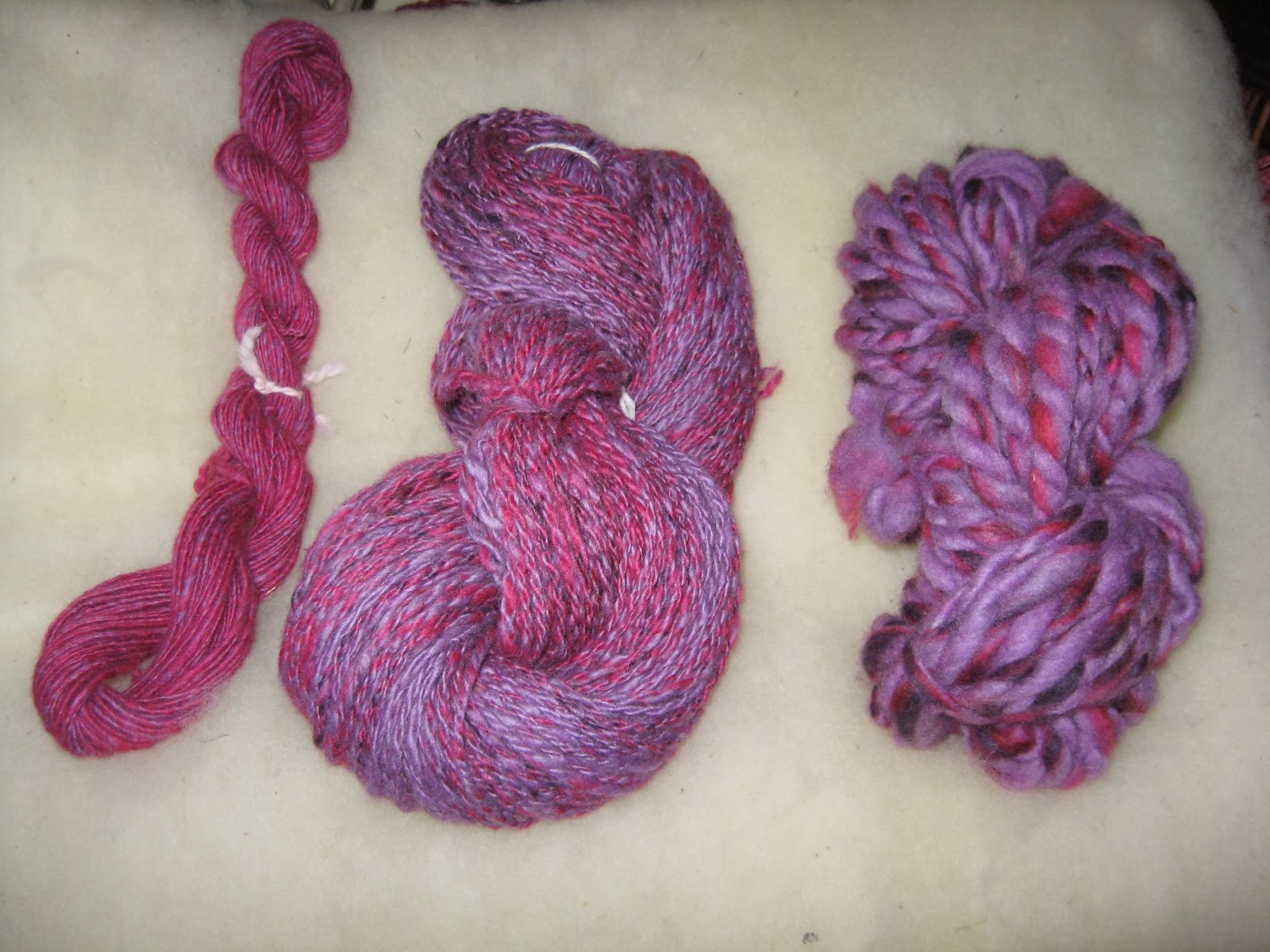
These are some of the most recently spun Finnsheep yarns.

They came directly "out of the bag" of roving from the mill, spun as they unwound, no choosing of colors on my part. The yarn on the left is a single - ply, the yarn in the middle is a two - ply and the yarn on the right is a two - ply bulky.

66 yards, 180 yards and 40 yards, respectively. In the meanwhile I've done something similar with the Border Cheviot I've been spinning as well as blending, so I've been productive this past week.

Soon it will be time to get back to the looms, but for now, I'll just spin and day dream!


Regards,
Kathryn


Thursday, December 12, 2013

Finnsheep Fleece

This blog post will be mostly quite subjective on my part, so you know that going forward.

 I started out raising a mixed flock of sheep with Corriedale, Clun Forest, Border Leicester X and Icelandic sheep. I became familiar with those types of wool, and through shearing sheep for others, also became familiar with a wide range of wool types.

As a wool buyer, I don't turn down any fleeces, because I love them all and find a purpose for each wool type that I take. One of the wonders of wool in the 21st century is that, among other attributes, it is versatile and regardless of the fineness or coarseness, it all has a place in the value added product marketplace.

Finn wool, ranges from animal to animal, from fine and crimpy with a medium staple length, to britchy, straight and course on some animals. Hand spinners in the USA are only now becoming familiar with this lovely, high luster wool. In some places a good, clean fleece, free of any hay chaff, burrs, dirt etc. will bring upwards of $20.00 per pound.

Finnsheep come in a variety of colors and it appears that breeders everywhere are concentrating efforts on understanding and producing consistent colored fleeces. While spots, stripes, and many different patterns and markings are possible, white still remains the best for dyeing. White fleeces also carry high luster giving a sheen to the finsished yarn that rivals mohair. Less true for colored fleeces.

When looking at a Finnsheep for wool quality, its important to check for uniformity in the fleece, from shoulder to tail. Often there is a "britch" wool on the hind legs that becomes course and straight. Many hand spinners will toss this as garbage, some will blend it, others will separate it, mix with similar, and use it for rugs. It all depends on what you want your final product to be.

One sure way to know the wool quality of your animals is to send a sample of the fleece to Yocum-McColl who will test it and send back a full report. Often this report is surprising, contrasting with the subjective analysis that results from touching, feeling and seeing the wool.

A fine Finn fleece would be one of 26 micron count, which is, according to Yocum-McColl, the equivalent of Merino wool.

A point to remember is that as a sheep ages, their wool tends to become more coarse. Most of us are aware that a lambs fleece is very, very soft and will be the softest of any fleece the sheep will have in the future.

Wool is a sustainable, renewable and earth friendly product. Sheep grow new wool each year, and depending on the breed, may give two fleeces/ year though most are shorn only once annually, and this in the early Spring prior to lambing.

Wool is coated with lanolin which the sheep produces through numerous glands on its skin. The lanolin content differs according to breed, with some having little lanolin, others having so much that simply handling the fleece covers your hands with it. This is usually referred to as "grease" and wool that is raw, not having been yet washed, is called "grease wool." Back in the day, wool was spun raw with the lanolin still on it and this gave rise to the term, "spinning in the grease."

There is some mixed info on whether or not leaving the lanolin on the yarn as it is spun will afford any water repellent qualities to the finished product. If I were to guess I would think that as long as the garment or textile isn't ever washed that degree of water repellence will remain, but once exposed to wash, will be removed. Just my guess.

I have spun in the grease myself, and enjoy handling wool with the higher degree of lanolin. When skirting raw fleeces with high lanolin content the lanolin will give the feel of a much softer fiber than truly exists, and this can be misleading. Once that wool is washed the true coarser nature is obvious.

Finn wool has a soft, almost silky feel to it that is quite noticeable in the finished yarn. This makes it a good wool for items that come in contact with one's skin where softness is appreciated.

Finn fleeces average somewhere around 6 - 8 pounds in my flock. Having shorn sheep that yield 12 pound fleeces, this doesn't seem like a lot per animal, but in a flock of 30 animals its 180 - 240 lbs of wool, which needs to be skirted, picked, washed, carded and spun. Plenty!

Finn fleece is pleasant spun raw, or from processed rovings, and it felts nicely making it a versatile wool for most fiber artists.

Check out these links for further info:

http://www.finnsheep.org/colors-markings-guide/


Excellent pictures and explanations:
http://www.internationalfinnsheepregistry.org/finn-wool.html


http://www.ymccoll.com/


To the right is Finn Ram, Clef with long staple, high luster wool. This sheen is readily apparent in yarn spun from his fleeces.

Wednesday, December 11, 2013

December 11, 2013

Bygone Days
December 11, 2013 here.

Snow on the ground, cold temps, clear air and weather that changes moment to moment no kidding.

The sheep are all settled in their winter enclosures.
Breeding has begun and indeed, is almost completed.

Spring 2014 will see new lambs again and I will be midwife to the ewes, a role I don't mind because it almost invariably has me playing a supporting part, one which allows me to simply watch.

Lambing time is stressful to say the least, much of which I bring on myself, admittedly since I can't stand the excitement of waiting for the lambs and feel I have to check on the ewes hourly. This ritual starts a good two weeks before I know they are due in the hope that I can stare the ewes into labor somehow. To date, no such luck!

There is little else that compares with seeing a long awaited and hoped for lamb, newly out of the
wrapper ( ewe ) shocked into this world and valiantly struggling to breathe, stand and nurse. Those first few moments and hours are tense for me and each year I vow not to put myself through it again, only to anticipate the next breeding season as soon as the current one has seen the last new lamb to be born for the year.

Now, winter is the time for weaving, spinning and gearing up for Spring. Around here this is often a phenomenon we have come to term " mud season".  Rather than a nice gradual warming up and flourishing of plants and creatures, we have snow which melts all at once causing flooding and making the ground obnoxiously muddy. This gives way to "April Showers" and our Spring is curtailed due to rain, mud and sometimes ice that makes the idea of starting spring farm chores a joke. Yet, we somehow survive and get things done anyway, and have come to anticipate this cycle.

So for now, I'll skirt fleeces, spin fiber and weave up as much as I can get done because its only 126 days until the first lambs are due! But...........who's counting?

Tuesday, November 19, 2013

Tuesday, November 19, 2013

Today dawns blustery, snowy and cold. It is the wind that brings the element of brutality to the climate. Without a doubt you understand immediately the life or death balance any mammal will face without adequate protection from the wind combined with the freezing temps.

Oddly enough, the ducks are happily paddling away on the stream which they will do all winter regardless of wind, cold, snow. They do very well on the water all year long.

Tomorrow will be an interesting day here on the farm as I am receiving three yearling ewes into the flock. These ewes were bred and born here, leaving to join another flock last winter. The flock has been disbanded and I was given the option of taking the yearlings back, so I agreed and tomorrow they arrive.

As far as I know now, that will be the end of any new animals joining our flock this year.

We are still offering three high quality ram lambs for sale, as well as two mature rams with proven breeding records.

In terms of ewes, I will be selecting replacements for some of the girls who are moving into older age. This will be hard to do because the breeding records for them have been superlative.

The three yearling ewes are all colored ranging from solid black ( which I love ) to HST ( head, socks, tail all white ) to piebald.

My intention is to expose the ewe flock to the rams at Thanksgiving which still gives me time to finalize the goals I'm creating.  I mull over the breeding pairs scrutinizing the pros and cons with an eye to eliminating as many cons as I can while instilling as many pros as I can. Then we will watch as nature takes its course, and wait.

In the beginning I am full of enthusiasm at the prospects but eventually this subsides as the day-to-day tasks overtake me, and for a few blessed weeks I forget the girls are bred but then......about six weeks from lambing time I start with renewed excitement. I think its a combination of knowing that winter is almost done, spring is almost on us, and imagining the lambs when they are born.

I watch the ewes like a hawk, checking on them every few hours and sometimes just sitting with them in the pasture for several hours at a time. This is therapeutic for me and seems to be okay with them too.

Despite my best efforts to be present for all lambing, I have a few girls who prefer to wait and lamb in secret, presenting me with freshly born, still wet lambs to help dry and monitor. 

Some ewes are seasoned dams and know what to do without any assistance from me, while the new mothers are sometimes a bit shell shocked and need some direction as they sort out their lambs, the feeding routine and all of the sensations they are bombarded with at lambing time.

This year the plan is to lamb in mid to late April, a full 8 weeks ahead of last years schedule, and I have a back up strategy for meat as well.

All things considered here it is a wonderful life albeit one where tough decisions have to be made to preserve the well being of the flock in general.

This has been a real learning year for this shepherd, bittersweet in many ways, but 2014 lies ahead and hope springs eternal!

Regards,
Kathryn
Ram lambs from 2012
 

Saturday, November 16, 2013

Saturday - Opening Day for Hunting

 November 16, 2013

Opening Day!

Its a beautiful cool, clear and sunny morning here for opening day of the 2013 hunting season.

We live in an excellent area for all types of wild life and deer are abundant so we hear and see quite a few hunters throughout the season.

Many of the small and not-so-small camps are bustling with activity and the traffic up and down our otherwise quite road, explodes.

Like most people, we have company - an old friend
and hunting buddy of the D.H.

As it happens, he's also a duck carver of many decades.

These past few years he's expanded into other
creatures and this year we were gifted with a very
unique and unusual carving of our beloved pet
Finn ram - Earl.

To say the carving looks like Earl is an understatement.


We are thrilled with the unexpected gift and honored to give it a place on our wall. How cool is that?
 
Over the last few days I've been preparing to finish off some textiles I've been working on.
The pictures are of a saddle blanket, a rug and a rug made solely from rovings. I'm still working on a throw blanket even as I prepare the loom for another saddle blanket. This one will be from Alpaca.
 
The rugs and saddle blanket are not yet finished, though the weaving is done. Remaining is the hemming and fulling and final touch with a steam iron, but in my impatience I went ahead and posted the photos knowing they aren't exactly the best. Can't help myself ! :-)
 
We are now down about 26 sheep from our original total this summer of 61.
While I feel I've culled, sold and parted with everyone I could afford to, we are still a bit on the heavy side as winter eases its way in.
 
As sorry as I am to see any leave as I love them all, I feel confident that those remaining are the beginning of a new core group that will advance the flock over time.
 
I've learned quite a few lessons from all of this selling of sheep.
 
1) Really, don't keep a ram longer than 2  years
 
2) Fiber being the priority for me, I see value in every sheep because it simply has wool. It is just as easy to have top quality sheep with excellent fleeces as it is to have lesser. Go for top quality.
 
3) Make up your mind from the beginning that sheep die, and be okay with orchestrating that when the time comes. As shepherds, we are both the midwives and the grim reaper when the need arises.
 
4) Because my role as shepherd is primarily one of care giver, it is understandably hard to STOP caring when the time comes to part with any animal. Be patient with yourself as you learn to do this.
 
At any rate, life moves on, things are good, hope abounds and we look to the future about five months from now, while we take the winter to hope, envision and expect new life in due course.
 
God is good!
Regards,
Kathryn


Wednesday, November 13, 2013

Premier Round Bale Feeder

Finnsheep Ewes
Now that summer pastures have gone dormant and snow is on the ground, we've started feeding hay.

We've been feeding a combination of round bales to the horses and square bales to the sheep because the square bales are small enough for me to handle without the need for equipment to move them.

While square bales are easier for me to handle, round bales are more economical. Our hay supplier does both so we have access according to what we want and need to feed.

In the past we have opted for round bales for the sheep, both with a traditional round bale feeder and just plopping them on the ground. Either way there seemed to be a good deal of waste as the sheep pulled out, trampled and laid down on the hay. Additionally, I found that hay in the wool was problematic too.
On the recommendation of a friend and fellow shepherd, this year we opted to try a round bale feeder from Premier Livestock supply in Iowa.

This feeder consists of square panels with square holes cut into them at two different heights. This allows both lambs and mature sheep access to the hay at the same time. The square panels are easily assembled and you can purchase as many as you think you need to make a small bale feeder or a large bale feeder.
Ours has been in place about four days now, and the difference was seen immediately. There is NO waste of hay with this feeder.  It is wonderful not to see the ground strewn with hay. The lambs can get to and reach the hay while the bigger ewes feed. This eliminates the tendency for someone to wait to eat, assuring that everyone is getting fed, not just the piggy ones.

The downside is that I cannot move the round bales myself but have to rely on D.H. Of itself this isn’t really a bad thing we just need to plan to move the new bale at a certain time.
The final downside is the shipping cost for the feeder. As far as I know the only way to get equipment from Premier is to have it shipped. This can be costly, but having considered this, I believe it is well worth the cost.
Check it out:
http://www.premier1supplies.com/detail.php?prod_id=99

 Regards,

Kathryn