Showing posts with label dyeing. Show all posts

Friday, April 11, 2014

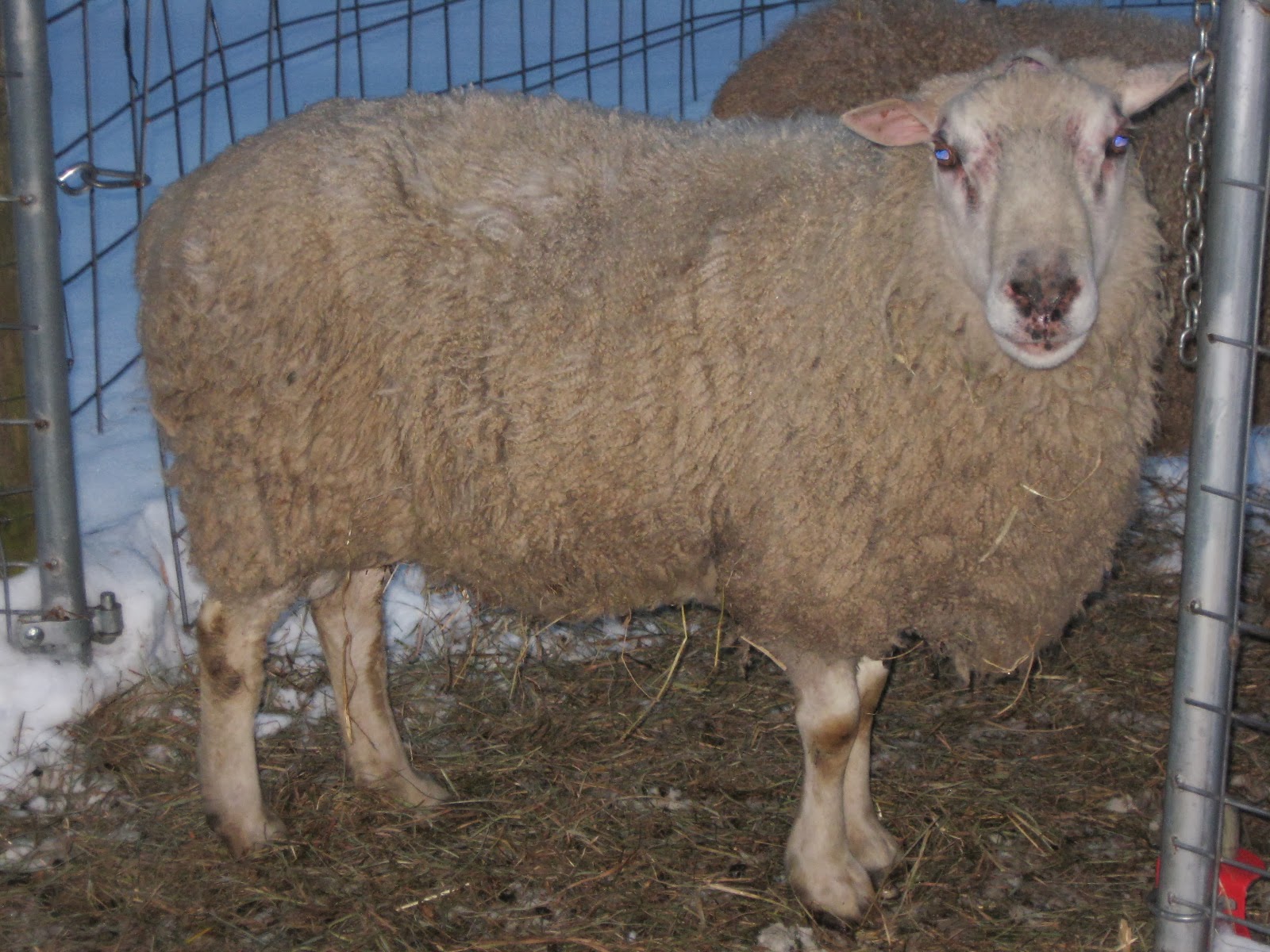
Corrigan - The Sire of Amelias' Lambs


Treble Cleft - Corrigans' Sire
Lana - Corrigans' Dam
 Corrigan is standing at right.
Amelia was bred last winter to Corrigan.

The ram is an important part of the breeding process in that 50% of the genetics the lambs receive will come from him.


The bloodlines of both Corrigans' dam and sire are very strong and long established lines, known for excellent maternal instincts, prolificacy, docile temperaments, among other traits.

Corrigans' sire carries for color and possibly spotting. His dam has yet to throw anything but white lambs, so I'm guessing she is genetically completely white.

What has me puzzled about Corrigan is a lone dark spot just above his shoulders on his neck. I often forget he has it, considering him to be a white sheep, but that spot says otherwise. Technically, it says he is a piebald ram, meaning spotted.

This is his first breeding and I chose Amelia for a few reasons, the least of which is the hope of bringing out any spotting Corrigan may possess. This could be the difference between whether he stays here a few more years, or is sold this spring.  His personality is very gentle and quiet, affectionate without being over bearing. Coupled with Amelias' similar personality perhaps the lambs from this pair will also have the same personalities.
Corrigan is on the heavier boned side, while Amelia is more refined with lighter bone structure. Personally I like both types, and so the lambs will be pleasing to me with either body type.

Fleece on Corrigan is a nice lock structure, with a staple length of 4 - 5 inches. His fleece is not consistent from head to toe, but has a range of long, wavy locks to finer, crimpier locks and I like that diversity.

Corrigan is a quadruplet, having two sisters and a brother. Amelia was a twin.


Amelia had a Badger Grey dam and a black sire. Her twin brother was Badger Grey. So far, she hasn't given me any Badger Grey lambs, and may not ever.
Corrigan - 2013

Freddie - Amelia's sire ( whom she favors a great deal )


Tipper - Amelias' Dam

Tipper is owned by Sweetland Hill Finnsheep in Chenango Forks, N.Y.


At this time I am beginning to get excited about the pending babies. It won't
be long before they are here, and as usual I have done and re-done the due date
several times. A few days ago I ran the calculations over in my head and in a panic thought
that I had given myself more time, calculating the due date as the 14th. Afraid that the lambs were actually due on the 9th I went into a frenzie of activity, then redid the calculations.
I discovered  that it is exactly the opposite and the lambs are due on the 18th, not the 14th so I have
an extra four days, God willing.  Even at that, its only 7 more days, and I'm praying for stable weather, day time lambing and being able to witness the lambs as they are born. Fingers crossed!

Regards,
Kathryn


Sunday, April 6, 2014

7 Days and Counting - Naming Lambs

Amelia with four lambs.


Early on we decided to go with the alphabetical order of naming the lambs, a different letter for each year. This year the letter is "G".

What this does is allow us to quickly recall what year a lamb was born in, according to the letter. "G" means its 2014, and our seventh year of lambing.

Now I excel at a great many things, but naming more than three lambs, is not one of them. I run out of ideas, so this task falls to hubby who is very good at it. He will research the internet and coming up with several options, presents them to me for a vote. I can yea or nay the name, and usually know right away if it is a fit for the lamb in question. Once in awhile I'll have to think on it a bit, then decide.

Hoping to get an early jump on it this year, I've considered some "G" names and typically have come up with my three - George, Giselle and Gaspar. Then of course the popular Gretchen, Gretel, Georgia, Gabby, Gwendolyn, Garth, Gary, Geoffrey. Well, looks like a good start anyway. By the end of lambing season we'll be long out of these names since I think we'll have about 40 or more lambs when its all said and done.

We do also tag the lambs with a number, but calling a cute little lamb # 181 just isnt' the same at all. And they ooze personality which fairly demands identifying them with a moniker that captures that personality. Being a small hobby farm, we can be as hokey as we like and at times I carry it to the max. Naming is one of those times :-).

At any rate, I need three "G" names by next week. Don't know if they will be girl or boy names yet, but I should have at least six - three of each just to be sure. Interestingly, I just noticed that without hesitation I said, " I'll need three "...hmmmmm......intuition?  Could be. Guess you'll have to stay tuned to find out how good I am at predicting how many lambs a ewe will have. I think this year will be triplets for Amelia. Care to bet?

Regards,
Kathryn

Friday, January 31, 2014

January 31, 2014

Corrigan - one of our 2014 sires
Wow, 1/12 of 2014 gone already! 


What is left isn't so bad....really.

February which is a "short" month ( I am so heartened by this! ) and then we are into March.

So, only four weeks until we begin the upside of the year with visions of warmth, lush new growth and lambs. I can handle that.
Caden - bred ewe for sale
 

We are still holding our own and the flock seems well despite the prolonged brutal cold. I'm thankful they are woolly creatures with enough protection from the cold and wind to be okay during these spells. Currently we are in a warm spell, with the daytime high being 20 and nighttime being around 10. Way better than the -20 night time temps we were having. And thankfully its a dry cold which makes even the brutal -degree temps bearable.

Oddly this winter we have two occurrences that remind me of Spring. One is a healthy flock of Blue Jays. The make a noise that I have associated with Spring since I was very young and due to their presence this winter, I  am constantly within earshot of their familiar song. Warmer days are coming!

The other is more sunshine than usual for this time of year. Not so much snowfall, and so the skies are clear and bright blue which is uplifting and greatly appreciated. Combined, both things help to keep me from falling into that winter time, cabin fever, blah mood.

I am impressed each year that the ewes are able to sustain themselves, grow beautiful wool and produce lambs even through these harsh conditions, and solely on a grass/hay based diet. They are well designed to do what they do, and the Finnsheep bring personality, affection and entertainment to the mix as well.

This year's lambing season has me a bit cautious with 21 ewes bred, the most I've had in my shepherding career. Six of these will be first timers. With that many ewes due to lamb, its quite possible that someone in the flock will have sextuplets or even septuplets and I expect the usual triplets which are fairly standard.

Last year, 11 bred ewes gave me 30 live lambs, so I would expect to have ....gulp...between 50 and 60 this year! I also don't have any plans to leave the property for about three months! 

First lambs of 2014 are due on April 15, which means I usually start getting excited about two weeks before and start trying to guess how many lambs the ewe will have. I have only 8 weeks until April 1. By then, maple sugaring time will have come and gone, and there should be definite signs of warmer, greener surroundings!

And of course there will be shearing time, with this year giving me 31 Finn fleeces to remove, skirt, pick and generally enjoy! Wool is the reason for having these beasties after all. At least it was the original reason. Now I just enjoy them on every level!

So, taking this all into account, my time for weaving and spinning with any regularity will be short now. So, I'm signing off to get as much textile production done as I can over the remaining few weeks of winter. 

Regards,
Kathryn


Wednesday, January 22, 2014

January 22, 2014 There are days..........

Horse Drawn Mower Waiting for Spring
There are days in the life of a shepherd that are beyond glorious, when all is well with the world and you know that God is in control.

Then there are the other days.

Don't get me wrong, nothing catastrophic has happened, no lost livestock or any unexpected problems to deal with. The flock is well even though the temp this morning was -13, and we are well.

It is just that in the middle of these long, dark, cold, overcast weeks of winter, I find myself slowly feeling discouraged.

I like winter as a rule, as long as I know the critters are handling it well, I don't mind the twice a day feeding/ checking up on animals and chores, and surprisingly I've come to realize that without those forced outings in all weather, I'd have missed some pretty amazing sights, sounds and moments that you cannot recapture.

Often, looking outside from the warmth of the cottage, its easy to dread stepping out, but most of the time I find once I am outside that it really is quite nice and end up staying outside doing more than I had originally intended because of it.

What I've observed personally is that the doldrums of winter are relieved not by warmer temps or less snow, but simply by sunshine. My spirits are enlivened again and my energy renewed by sunshine.

I don't miss the heat of summer, in fact I dread that more than the cold because it is impossible to escape it and the bulk of the work has to be done at this time. But the sunshine is always a welcome sight coming over the treetops lighting up the day.

The good news is, January will be behind us in 9 days. February in 28 after that. Then comes March and no matter what wacky weather it holds, I know we're on the upswing and the days will get longer, the sun will shine more, and eventually the greenery will return along with bouncing lambs, freshly shorn fleeces and all the warmth I can stand!

So for now, I occupy myself with spinning, weaving, making herbal salves and creams, shoveling and staying warm along with the usual routine chores.

And daydreaming - 83 more days until lambs!

Regards,
Kathryn


Sunday, January 19, 2014

Line Breeding


Sunday morning here. Slow start and then the momentum gradually picks up.

Coffee and plenty of it.

As I sip my cuppa, I think about the coming lambs and remember back to my early shepherding days when breeding stock was a new challenge.

With Finnsheep being small in number in the USA, getting unrelated breeding stock to develop separate bloodlines isn't easy, and the importation of semen from Finland was prohibited.

Initially I was adamant that my breeding animals be unrelated but quickly I learned that within five generations almost all of  the animals are related, with few exceptions.

Due to the efforts of a few Finnsheep breeders with decades of experience, there are a few lines that are completely unrelated but not many.

So I began to get familiar with terms like: inbreeding, crossbreeding, line breeding and out breeding.

Also the term " closed flock. "

Once I determined that I had the number of animals I wanted, I decided to close the flock, meaning no new animals from different sources would be allowed. This minimizes the potential for disease and gives me less to worry about.

But, what can come of it eventually, is that your stock becomes more and more closely related until such time as you do decide to open the flock and bring in new blood. Then it is time to quarantine the new animal until you can be assured it poses no threat to the established flock.

In the meanwhile, various breeding's result in bloodlines with common characteristics among the related animals and these can be good or bad or both.

In the animals with a number of very strong traits, a desire to preserve and perpetuate those traits leads a shepherd to begin considering line breeding, or a deliberate pairing of animals with common ancestors, in the hope of enhancing the existing traits or at a minimum passing good traits on to more progeny.

Unfortunately, this can also result in enhancing of negative traits as well.

Understanding this, and having a willingness to deal with the negatives through culling, leaving only the stronger and better animals, is the intention of line breeding.

Under these circumstances it is desirable to breed related animals, and not such a scary proposition as I once believed.

In the end, what you intend to do with your flock, is what determines whether line breeding is a choice or not.
Lambs destined for the meat market are terminal early on in their lives so negative characteristics aren't going to be passed on. Line breeding isn't a problem there.

Breeding stock, especially that to be sold to other shepherds, needs to be top quality so culling of less than superior animals is a must.

If pets and fiber animals with a fleece worthy enough to keep, then some negative traits aren't an issue as long as the negative animal isn't used for breeding or exhibits traits known to impact the animals quality of life.

This info isn't intended to be a guide or tutorial, simply food for thought and one of the issues I've learned about as my shepherding experience has unfolded over time.

I'd encourage anyone who is interested to educate themselves on line breeding.

This is an interesting explanation
:
http://www.critterhaven.biz/info/articles/1_ram.htm

Regards,
Kathryn

Saturday, January 11, 2014

January 11, 2014

We've come through the Arctic blast without incident, and now we're braving the ice covered frozen ground saturated with rain. The warnings now are for flooding due to the rain and melting snow.
Mere walking outside is life threatening without proper foot gear, and driving all the more so.

Oddly there have been moments when it feels much like early spring and I think for an instant that it is time to tap trees for sugaring and lambs aren't far off. Then I realize we have another 15 weeks or so of winter and ponder what lies ahead.

Breeding has ceased and the ewes have been paired with three rams this year. A white ram, who carries for color and spotting, a brown ram and a piebald. I am, as ever, excited at the prospects.

The expectation is for at least 40 lambs and closer to 50, so I've made the decision that all ram lambs will be sold to the meat market, unless I have a buyer. While difficult, the revenue will allow for maintaining the fiber and breeding stock.

We are now excepting deposits for reservations on lambs, and also on fleeces. This year there will be 31 fleeces from a variety of different colored sheep, white being predominant and excellent for dyeing.

I'm happy to answer questions and speak with shepherds or potential shepherds regarding the flock and lamb purchases. Feel free to ask.

Also happy to accept deposits on 2014 fleeces as well, contact me for pictures and details.

Regards,
Kathryn


Saturday, January 4, 2014

January Happenings

https://www.etsy.com/shop/oldschoolhandwovens?ref=si_shop
The big news for January is that we have re-opened our Etsy Shop known as oldschoolhandwovens.

Listings will be added slowly but steadily as I interject the shop tasks with the rest of the goings on here. Please be patient with me. Any questions about goods or services, please ask, don't be shy!

On another note, the sheep have come through the bitter weather well, to my relief.

Our newest shelter, the larger hoop house with the brown cover is proving to exceed my expectations.

Unlike previous hoop house shelters, this one, designed by my DH, utilizes aluminum piping bent and welded for extra strength against the snow loads and high winds. Its tall enough for me to walk around in which is a huge plus as walking hunched over in a half crouch really isn't fun or conducive to taking care of bedding etc.

 The size of the structure makes it easier for me to work in, accommodates more sheep, and will allow for the cleaning it out in the spring to be much more readily accomplished. All this and I can still reach up from the inside to slap the roof and knock the snow off without aid of a tool to assist. All good. Kudos to DH for doing a great job!

Having considered how much I like this new building I've concluded the only element missing is a way to close both ends.
 For the most part the sheep should have the choice of entering or leaving, but there are times when closing them in securely is necessary and as yet, we haven't devised a method to do so, though I have a plan to create swinging gates.
These will most likely be constructed from cattle panels cut in two sections. When added to the end of the structure, they will swing inward to open and keep them out of the way until such time as it is appropriate to close them. Then they will swing outward, coming together in the middle where they will be secured. Easy!

Next year I'll have another just like it and then for all intents, I will be set on critter housing.

One thing about farm life that is certain - the more skills you have and the more things you can do yourself, the better off you will be. Everything from vet skills to growing and preserving food are vital. Thank God we followed our interests early in our lives, as quirky as they seemed to friends and family, because its those skills we now rely on.  It is funny how in hindsight we were preparing for this lifestyle even without truly realizing it.

Now if we could only bale our own hay!

Regards,
Kathryn


Saturday - January 4, 2014

You can now find some of our hand spun yarns and hand woven items here: on Etsy.

https://www.etsy.com/shop/oldschoolhandwovens?ref=si_shop


Oh glory day! The sun is bright and shinning on the mountainside across the road, making an inspiring invitation to arise, step out and participate in the coming day!
What an awesome and promising moment in time, Thank You God!

That said, I find myself daydreaming in the early days of the new year. So much to look forward to now that we have turned the corner from old year, to impending Spring. Such promise.

These days in between Christmas and New Year found me spinning like crazy. I have alot of fiber that needs to be taken from its raw ( in the case of shorn fleeces ) or processed ( in the case of mill processed roving ) state into its spun, woven or felted state and the sooner the better. I like the tactile nature of creating things from dyed, blended and spun fiber so I don't find it a chore but rather a delight for the most part.

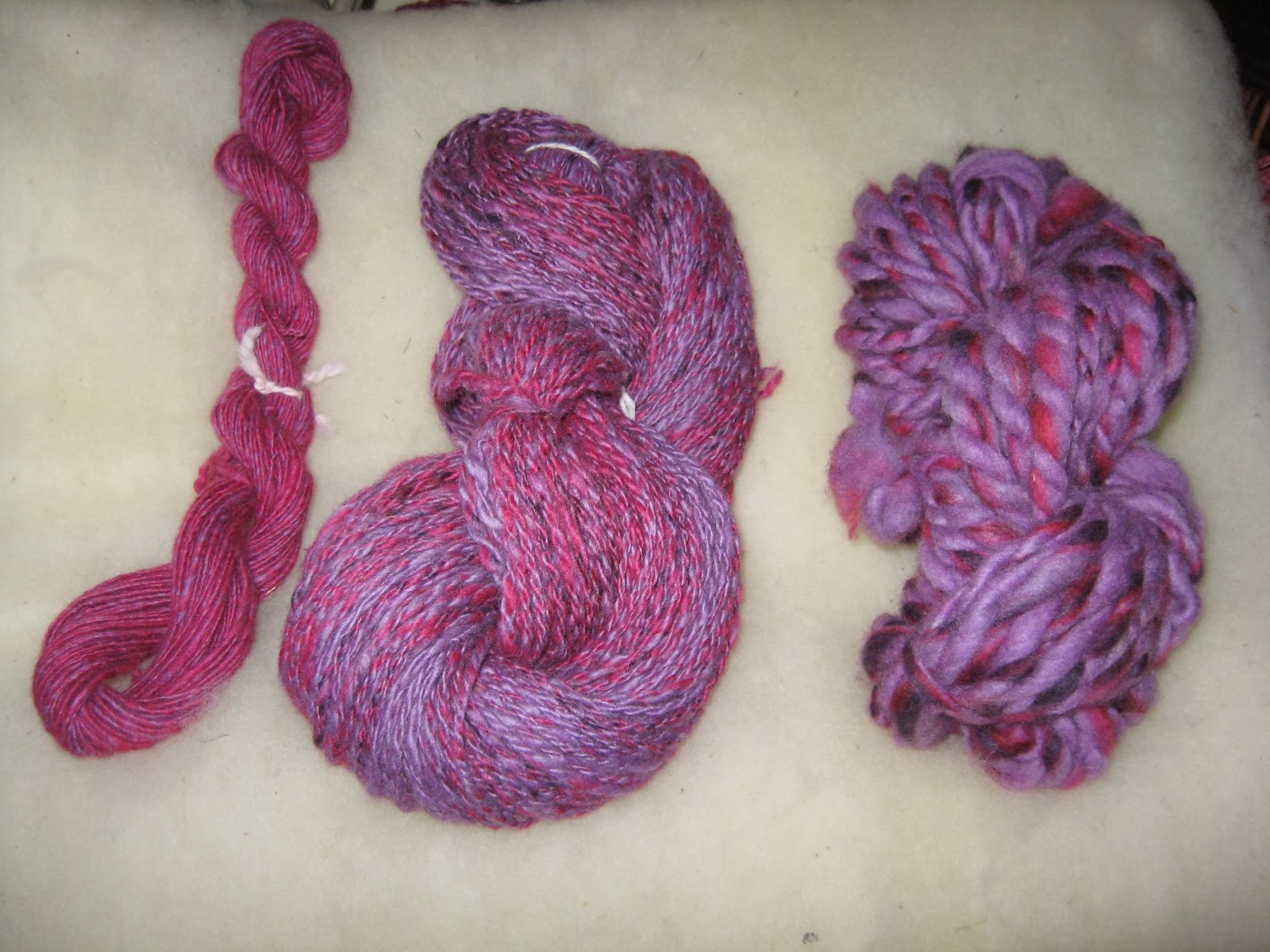
These are some of the most recently spun Finnsheep yarns.

They came directly "out of the bag" of roving from the mill, spun as they unwound, no choosing of colors on my part. The yarn on the left is a single - ply, the yarn in the middle is a two - ply and the yarn on the right is a two - ply bulky.

66 yards, 180 yards and 40 yards, respectively. In the meanwhile I've done something similar with the Border Cheviot I've been spinning as well as blending, so I've been productive this past week.

Soon it will be time to get back to the looms, but for now, I'll just spin and day dream!


Regards,
Kathryn


Saturday, December 14, 2013

Sheep - Mothers and Daughters


Just a hopeful reminder that Spring will come again!
 
As I've stated in previous posts, I am fortunate enough to be able to spend a good deal of time just observing the sheep in our flock.

We maintain two separate groups based on gender - a ewe flock and a ram flock, for most of the year.
This differs at breeding time and lambing time. For breeding purposes, select rams are given access to the ewes and at lambing time the ram lambs stay with their dams until weaning time.

One of the observations I've made repeatedly is the bond between ewes and their lambs. Call me crazy, but I have had occasion to part with a lamb, only to regain possession of it at some future date well after it has matured.

What I have seen is both consistent and bears out the idea of familial bonds that last a good long time.

When a ewe lamb now matured is reintroduced into our flock, the ewe lamb almost immediately recognizes its dam and makes quick attempts to greet and acknowledge her dam. The reactions on the part of the young ewe have ranged from approaching the dam and interacting to actual jubilant jumping and leaping about at the reunion. These young lambs are just about 12 - 18 months old at the time of the reacquainting, and the separation could be as little as two weeks, to over a year.

My first experience with this was after I purchased three ewes, who were dam, daughter and dams' sister.
Circumstances allowed me to take one ewe initially and she was not a happy girl when introduced to her new flock. Two weeks later her dam and aunt arrived and the joy expressed by the young ewe was very interesting to watch. This exuberant leaping and cavorting carried on all afternoon.

Any other reintroductions are much the same on the part of the young ewe.

My second observation has been the reaction of the dam - while signs of recognition on her part are clear, she is less enthused and maintains an air of indifference. "Oh, its you." Yet they tend to band together none the less, within the flock itself.

I cannot testify to ram lambs and their dams as I make a pointed effort NOT to reintroduce them, EVER.  My experience with the young rams is that they are happy to meet any ladies at all regardless of familial connection. My impression is that greetings between ewe and ram are minimal and whether or not a ewe is the dam of a particular ram is of no interest to the young ram.

This is just one more thing that makes shepherding animals that most folk refer to as "stupid" quite interesting. In my experience they are far, far from stupid.

Regards,
Kathryn

Friday, December 13, 2013

December 13, 2013

14 degrees here this morning. Dry, clear, cold. Really nice!

The first pic is the winter shelters for the ewes.

Pic #2 is one of the breeding groups. Three ewes and a ram.

Pic #3 is the main ewe flock leaving their Premier round bale feeder to come see me as I take their pic.

Pic #4 is Earls' Brother. Perhaps one of THE friendliest and trusting rams I've ever owned. He is a classic example of those sheep who seek out human interaction and affection. I love him!
 Pic #5 is of Freckles (R) and Andy (L). Both lively, curious and friendly boys. Andy is one of the flock sires this year. Hopefully Freckles will be too.

And last - the Percheron team, Paladin (R) and Dick (L).

Yesterday I dropped off some wool products in town at the whole foods store, and have begun to plan for a website where we can showcase and offer our hand made wool items.

Today I'll be immersed in weaving and spinning after feeding the critters.
 I'm waiting for some fiber to come back from the mill and getting ready to send out more. This time I'll send out more organic wool and some fiber to make wool mattress toppers and comforters. I've been wanting to do that for a long time. I also have a few more pelts to ship.

So, daylight is coming and its time to suit up for the feeding and watering chores before everyone starts calling to me.

Regards,
Kathryn


Thursday, December 12, 2013

Finnsheep Fleece

This blog post will be mostly quite subjective on my part, so you know that going forward.

 I started out raising a mixed flock of sheep with Corriedale, Clun Forest, Border Leicester X and Icelandic sheep. I became familiar with those types of wool, and through shearing sheep for others, also became familiar with a wide range of wool types.

As a wool buyer, I don't turn down any fleeces, because I love them all and find a purpose for each wool type that I take. One of the wonders of wool in the 21st century is that, among other attributes, it is versatile and regardless of the fineness or coarseness, it all has a place in the value added product marketplace.

Finn wool, ranges from animal to animal, from fine and crimpy with a medium staple length, to britchy, straight and course on some animals. Hand spinners in the USA are only now becoming familiar with this lovely, high luster wool. In some places a good, clean fleece, free of any hay chaff, burrs, dirt etc. will bring upwards of $20.00 per pound.

Finnsheep come in a variety of colors and it appears that breeders everywhere are concentrating efforts on understanding and producing consistent colored fleeces. While spots, stripes, and many different patterns and markings are possible, white still remains the best for dyeing. White fleeces also carry high luster giving a sheen to the finsished yarn that rivals mohair. Less true for colored fleeces.

When looking at a Finnsheep for wool quality, its important to check for uniformity in the fleece, from shoulder to tail. Often there is a "britch" wool on the hind legs that becomes course and straight. Many hand spinners will toss this as garbage, some will blend it, others will separate it, mix with similar, and use it for rugs. It all depends on what you want your final product to be.

One sure way to know the wool quality of your animals is to send a sample of the fleece to Yocum-McColl who will test it and send back a full report. Often this report is surprising, contrasting with the subjective analysis that results from touching, feeling and seeing the wool.

A fine Finn fleece would be one of 26 micron count, which is, according to Yocum-McColl, the equivalent of Merino wool.

A point to remember is that as a sheep ages, their wool tends to become more coarse. Most of us are aware that a lambs fleece is very, very soft and will be the softest of any fleece the sheep will have in the future.

Wool is a sustainable, renewable and earth friendly product. Sheep grow new wool each year, and depending on the breed, may give two fleeces/ year though most are shorn only once annually, and this in the early Spring prior to lambing.

Wool is coated with lanolin which the sheep produces through numerous glands on its skin. The lanolin content differs according to breed, with some having little lanolin, others having so much that simply handling the fleece covers your hands with it. This is usually referred to as "grease" and wool that is raw, not having been yet washed, is called "grease wool." Back in the day, wool was spun raw with the lanolin still on it and this gave rise to the term, "spinning in the grease."

There is some mixed info on whether or not leaving the lanolin on the yarn as it is spun will afford any water repellent qualities to the finished product. If I were to guess I would think that as long as the garment or textile isn't ever washed that degree of water repellence will remain, but once exposed to wash, will be removed. Just my guess.

I have spun in the grease myself, and enjoy handling wool with the higher degree of lanolin. When skirting raw fleeces with high lanolin content the lanolin will give the feel of a much softer fiber than truly exists, and this can be misleading. Once that wool is washed the true coarser nature is obvious.

Finn wool has a soft, almost silky feel to it that is quite noticeable in the finished yarn. This makes it a good wool for items that come in contact with one's skin where softness is appreciated.

Finn fleeces average somewhere around 6 - 8 pounds in my flock. Having shorn sheep that yield 12 pound fleeces, this doesn't seem like a lot per animal, but in a flock of 30 animals its 180 - 240 lbs of wool, which needs to be skirted, picked, washed, carded and spun. Plenty!

Finn fleece is pleasant spun raw, or from processed rovings, and it felts nicely making it a versatile wool for most fiber artists.

Check out these links for further info:

http://www.finnsheep.org/colors-markings-guide/


Excellent pictures and explanations:
http://www.internationalfinnsheepregistry.org/finn-wool.html


http://www.ymccoll.com/


To the right is Finn Ram, Clef with long staple, high luster wool. This sheen is readily apparent in yarn spun from his fleeces.

Tuesday, November 19, 2013

Tuesday, November 19, 2013

Today dawns blustery, snowy and cold. It is the wind that brings the element of brutality to the climate. Without a doubt you understand immediately the life or death balance any mammal will face without adequate protection from the wind combined with the freezing temps.

Oddly enough, the ducks are happily paddling away on the stream which they will do all winter regardless of wind, cold, snow. They do very well on the water all year long.

Tomorrow will be an interesting day here on the farm as I am receiving three yearling ewes into the flock. These ewes were bred and born here, leaving to join another flock last winter. The flock has been disbanded and I was given the option of taking the yearlings back, so I agreed and tomorrow they arrive.

As far as I know now, that will be the end of any new animals joining our flock this year.

We are still offering three high quality ram lambs for sale, as well as two mature rams with proven breeding records.

In terms of ewes, I will be selecting replacements for some of the girls who are moving into older age. This will be hard to do because the breeding records for them have been superlative.

The three yearling ewes are all colored ranging from solid black ( which I love ) to HST ( head, socks, tail all white ) to piebald.

My intention is to expose the ewe flock to the rams at Thanksgiving which still gives me time to finalize the goals I'm creating.  I mull over the breeding pairs scrutinizing the pros and cons with an eye to eliminating as many cons as I can while instilling as many pros as I can. Then we will watch as nature takes its course, and wait.

In the beginning I am full of enthusiasm at the prospects but eventually this subsides as the day-to-day tasks overtake me, and for a few blessed weeks I forget the girls are bred but then......about six weeks from lambing time I start with renewed excitement. I think its a combination of knowing that winter is almost done, spring is almost on us, and imagining the lambs when they are born.

I watch the ewes like a hawk, checking on them every few hours and sometimes just sitting with them in the pasture for several hours at a time. This is therapeutic for me and seems to be okay with them too.

Despite my best efforts to be present for all lambing, I have a few girls who prefer to wait and lamb in secret, presenting me with freshly born, still wet lambs to help dry and monitor. 

Some ewes are seasoned dams and know what to do without any assistance from me, while the new mothers are sometimes a bit shell shocked and need some direction as they sort out their lambs, the feeding routine and all of the sensations they are bombarded with at lambing time.

This year the plan is to lamb in mid to late April, a full 8 weeks ahead of last years schedule, and I have a back up strategy for meat as well.

All things considered here it is a wonderful life albeit one where tough decisions have to be made to preserve the well being of the flock in general.

This has been a real learning year for this shepherd, bittersweet in many ways, but 2014 lies ahead and hope springs eternal!

Regards,
Kathryn
Ram lambs from 2012
 

Tuesday, November 12, 2013

Tuesday, November 12, 2013

Blech!

7 a.m. and still dark-ish out, certainly overcast and snowing. I am not, not, NOT ready. Blech.

On todays' agenda, among many things, is making a final decision on who goes to the auction this week. I have mature rams, ram lambs and ewe lambs. If I'm to be honest and really harsh, there is even a mature ewe or two that should be on the trailer this trip.

BUT...ahem...flock goals, what about flock goals? Seems like lately I've lost track of what those were if I ever knew to begin with.

My first elementary goal was to have fleece. Any sheep would do, didn't matter breed, gender or even fleece quality in the beginning. I was so thrilled to have my own ovine I wasn't picky.

Then the reality of caring for a growing flock set in. I've always been athletic-ish, and strong, able - bodied but as time marches on I find myself slowing up just a bit and becoming a tad bit pickier ( is that a word? ) about the tasks I take on and under what circumstances.

Gradually I made the transition from a mixed flock to a purebred flock of Finns because they are just plain delightful and easy to work with. Easy to move, fun companionship, colorful fleeces and the cutest lambs in the world. No brainer.

Of course it doesn't take much to increase the flock. I brought in new breeding stock with the idea of selling some of the older animals, had 30 lambs, and assimilated animals from a friends' flock and here I am. Too many sheep for the resources.

They are all wonderful, each with its' own special quality that makes it somewhat of a consideration for keeping. No lamb left behind and all that.

If I were to revisit flock goals and look at simply growing wool, then 40 would be about right. Finn fleeces aren't overly large and as a weaver I use a lot of wool in my projects, so the more wool critters the better from that stand point. No need to breed any more unless I lose someone to sale or death.

The flock is predominantly white, with a few colored animals tossed in because we are just beginning to have a few generations that are displaying color. I like the white most especially for dyeing, but it sure is fun to look at all those colored sheep in the field too.

Then there are bloodlines. I'd like to establish three or four separate and distinct bloodlines to allow for greater diversity in breeding groups and of course that requires a few rams I wouldn't usually need.

I'm seriously considering not breeding this year, just to give myself a break, and this could be a viable plan but how sad to be lamb-less come the regeneration of Spring.  Sometimes I think lambs are the sole reason for having sheep. So much cuteness all in one package. Not to mention genetic potential for furthering the breed.

Well, frankly, my head hurts. And to be honest there are those moments where I think everyone should just go, and be done.

I have my original rams who've done a great job with the gene pool, have excellent fleece and I had hoped for them to retire and die of old age here.

I have some of their offspring, also rams, that for one reason or another I haven't gotten around to using yet, but someday....

I have ram lambs that are outstanding in confirmation , temperament and fleece with exactly the right bloodlines I need, I cannot bear to part with ...yet.

There are ewes that are the matriarchs and too good to let go, their daughters who are just getting warmed up, and their daughters who are too young to breed this year, but will give grand fleece in the spring.

Geeze, wish me luck!

Regards,
Kathryn