Amelia is enjoying the milder temperatures, her new space and the company of her companion, Lana.
She gets rations twice a day of whole corn/ soy meal / minerals and some choice second cut hay to provide the nutrients both she and the lambs need.
Plenty of water and fresh air are also available and she rests or moves about as she feels inclined.
She is in good health and fine spirits, with a hefty appetite.
Positioned in a small area behind the house it is ideal for me to keep a regular watch for any signs of deviation from the regular behavior. As I go about the chores of housekeeping, weaving, and fiber business, I can look up and quickly get a visual on her. This all but ensures I will know when she is in labor and be present as the lambs are born.
Unless she decides to have them in the middle of the night. Not to jinx myself, but she has had all of her lambs so far, during the daytime, and so hopefully this will be no different.
Can't wait, can't wait!!! Its like Christmas, birthday, Valentines Day and Anniversary all rolled into one. Woo Hoo......hope the weather holds :-).
Regards,
Kathryn
Showing posts with label spinning. Show all posts
Sunday, April 13, 2014
Saturday, April 5, 2014
8 Days Left
Although it's a matter of weeks now before this picture of summer pasture becomes reality, winter just won't let go yet.
So far today we've had drizzle, hail and high winds. Tomorrow the high will be 52 according to the weather forecast.
We can hope.
In the meanwhile, the girls are all doing well, and enjoying their grain rations with great relish.
| Evening rations |
I like to mix my own rations, for no particular reason aside from enjoying it, and so they get whole corn, whole oats, soybean meal and loose minerals. Plenty of water, unlimited access to second cut hay and whatever grass they can find at this point. Healthy lambs start with sound nutrition for the dam, as does ample milk supply and rapid recovery.
My experience has been that once the lambs are born and the dam is nursing them, its as if their resistance to parasites is lowered and I find symptoms of Hoemoncus Contortus, ( Barber Pole ) worm within a short time frame from lambing. Once wormed, that seems to put the problem of parasites to rest and no further treatment is necessary.
Today will be a day for working on getting the lambing jug prepared. Cleaning out, rebedding and moving the two ewes closest to lambing are all on the agenda for the next week. Lambs will be here before we know it!
Regards,
Kathryn
Labels:
breeding Finnsheep,
breeding stock for sale.,
CNY,
fine fleeces,
Finnsheep,
Finnsheep Breeders Assocation,
flushing,
lambs,
ram lambs,
rams,
reserving 2014 lambs,
sheep for sale,
spinning,
weaving
Saturday, March 22, 2014
March 22, 2014
| I love those faces! |
| Grey - trying to figure out what I'm up to and hoping it is more grain. |
As the days grow longer and warmer, the girls are getting rounder and rounder.
It's just a matter of time now.
The first lambs are due on April 15th, and I'm getting a bit more observant of the ewes in general and Amelia in particular, the dam who is due to lamb first this year.
She is fairly large as usual, though she still has three weeks left.
She always has big lambs and last year had four.
With all the fleece on it's hard to tell but I don't think it will be four this year.
I'd be happy with twins, but triplets are more likely.
She was bred to a different ram, one who himself is all white but for one lone spot on his neck.
To test and see if he carries the spotting gene, I decided to breed him to Amelia who is confirmed to carry spotting. We'll see what comes in terms of color but I'm expecting white and black depending on how many lambs she has. If I get a nicely spotted ewe lamb, that would be great!
This year we've chosen to feed the girls second cut round bales all winter, using a Premier hay feeder which has greatly reduced any waste.
The down side to this is that they stick their heads into the feeder, rubbing away any wool on their necks. You can see this in the pictures.
The up side is.I don't have to worry about shearing their neck and throats this year. That is always a tricky and nervous task because I worry about cutting their throats, but so far, not a problem, and definitely won't be an issue this year.
While the ewes have access to hay 24/7 and now are getting grain supplements, I found it curious that several of them seem to be constantly poking in the snow. Sure that they had plenty of drinking water I shrugged and forgot about it.
Last night as I was taking these photos I realized that Amelia had located a stem or two of GRASS! and was digging through the snow much like the deer do, to reach it. God Bless her. One of the pics shows Amelia in the foreground scoping out that pitiful little bit of grass. You can see how wide she is. Won't be long now for lambs and grass. The girls will be happy.
Regards,
Kathryn
| Amelia ferreting out the grass under the snow. |
| Hoping for more grain. |
Labels:
breeding stock for sale.,
fiber,
Finnsheep,
fleece,
homesteading,
lambs,
shearing,
spinning,
weaving,
wool
Saturday, January 4, 2014
Saturday - January 4, 2014
You can now find some of our hand spun yarns and hand woven items here: on Etsy.
https://www.etsy.com/shop/oldschoolhandwovens?ref=si_shop
Oh glory day! The sun is bright and shinning on the mountainside across the road, making an inspiring invitation to arise, step out and participate in the coming day!
What an awesome and promising moment in time, Thank You God!
That said, I find myself daydreaming in the early days of the new year. So much to look forward to now that we have turned the corner from old year, to impending Spring. Such promise.
These days in between Christmas and New Year found me spinning like crazy. I have alot of fiber that needs to be taken from its raw ( in the case of shorn fleeces ) or processed ( in the case of mill processed roving ) state into its spun, woven or felted state and the sooner the better. I like the tactile nature of creating things from dyed, blended and spun fiber so I don't find it a chore but rather a delight for the most part.
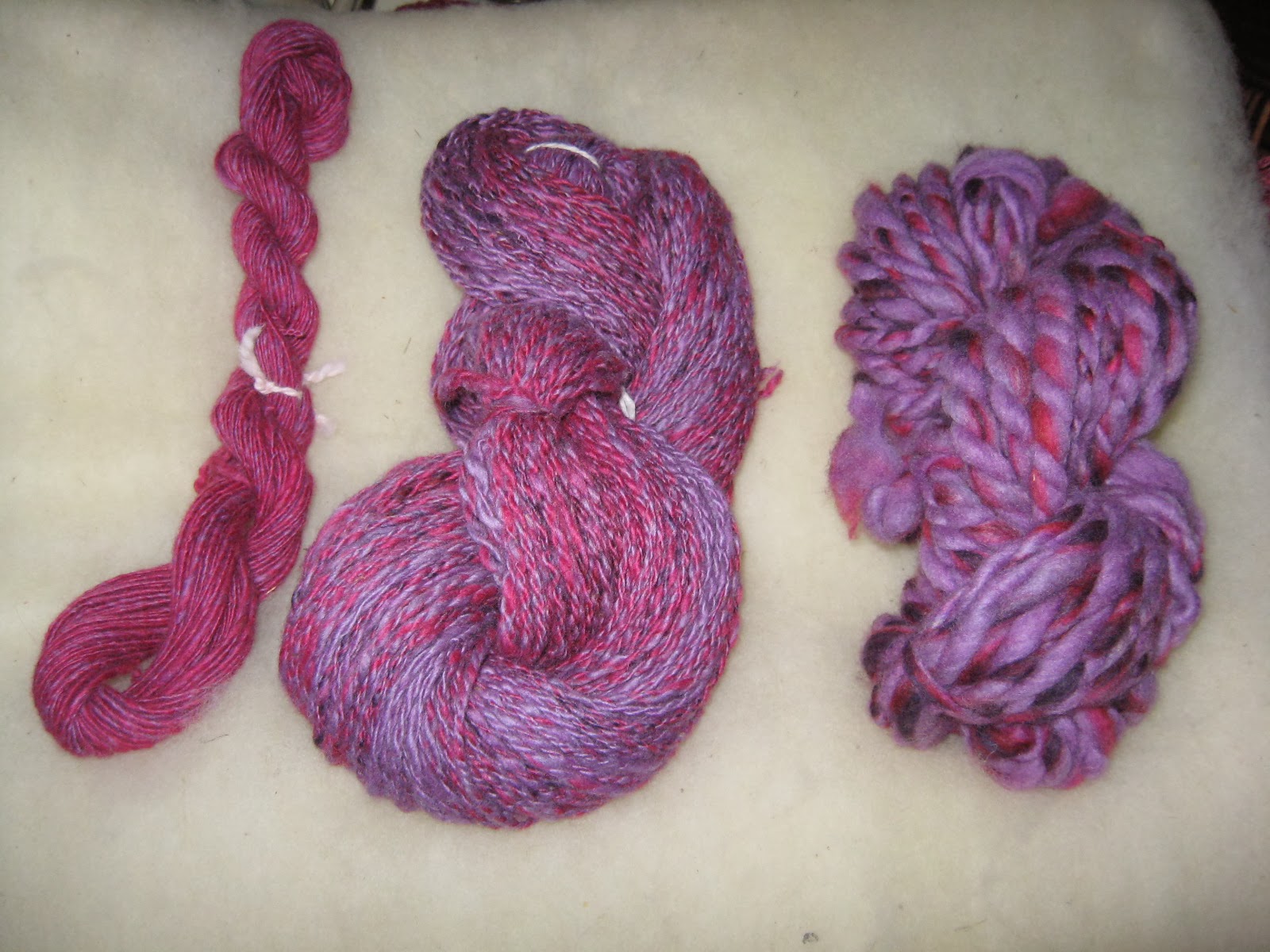
These are some of the most recently spun Finnsheep yarns.
They came directly "out of the bag" of roving from the mill, spun as they unwound, no choosing of colors on my part. The yarn on the left is a single - ply, the yarn in the middle is a two - ply and the yarn on the right is a two - ply bulky.
66 yards, 180 yards and 40 yards, respectively. In the meanwhile I've done something similar with the Border Cheviot I've been spinning as well as blending, so I've been productive this past week.
Soon it will be time to get back to the looms, but for now, I'll just spin and day dream!
Regards,
Kathryn
Friday, December 13, 2013
December 13, 2013
The first pic is the winter shelters for the ewes.
Pic #2 is one of the breeding groups. Three ewes and a ram.
Pic #3 is the main ewe flock leaving their Premier round bale feeder to come see me as I take their pic.
Pic #4 is Earls' Brother. Perhaps one of THE friendliest and trusting rams I've ever owned. He is a classic example of those sheep who seek out human interaction and affection. I love him!
Pic #5 is of Freckles (R) and Andy (L). Both lively, curious and friendly boys. Andy is one of the flock sires this year. Hopefully Freckles will be too.
And last - the Percheron team, Paladin (R) and Dick (L).
Yesterday I dropped off some wool products in town at the whole foods store, and have begun to plan for a website where we can showcase and offer our hand made wool items.
Today I'll be immersed in weaving and spinning after feeding the critters.
I'm waiting for some fiber to come back from the mill and getting ready to send out more. This time I'll send out more organic wool and some fiber to make wool mattress toppers and comforters. I've been wanting to do that for a long time. I also have a few more pelts to ship.
So, daylight is coming and its time to suit up for the feeding and watering chores before everyone starts calling to me.
Regards,
Kathryn
Tuesday, November 12, 2013
Blech!
7 a.m. and still dark-ish out, certainly overcast and snowing. I am not, not, NOT ready. Blech.
On todays' agenda, among many things, is making a final decision on who goes to the auction this week. I have mature rams, ram lambs and ewe lambs. If I'm to be honest and really harsh, there is even a mature ewe or two that should be on the trailer this trip.
BUT...ahem...flock goals, what about flock goals? Seems like lately I've lost track of what those were if I ever knew to begin with.
My first elementary goal was to have fleece. Any sheep would do, didn't matter breed, gender or even fleece quality in the beginning. I was so thrilled to have my own ovine I wasn't picky.
Then the reality of caring for a growing flock set in. I've always been athletic-ish, and strong, able - bodied but as time marches on I find myself slowing up just a bit and becoming a tad bit pickier ( is that a word? ) about the tasks I take on and under what circumstances.
Gradually I made the transition from a mixed flock to a purebred flock of Finns because they are just plain delightful and easy to work with. Easy to move, fun companionship, colorful fleeces and the cutest lambs in the world. No brainer.
Of course it doesn't take much to increase the flock. I brought in new breeding stock with the idea of selling some of the older animals, had 30 lambs, and assimilated animals from a friends' flock and here I am. Too many sheep for the resources.
They are all wonderful, each with its' own special quality that makes it somewhat of a consideration for keeping. No lamb left behind and all that.
If I were to revisit flock goals and look at simply growing wool, then 40 would be about right. Finn fleeces aren't overly large and as a weaver I use a lot of wool in my projects, so the more wool critters the better from that stand point. No need to breed any more unless I lose someone to sale or death.
The flock is predominantly white, with a few colored animals tossed in because we are just beginning to have a few generations that are displaying color. I like the white most especially for dyeing, but it sure is fun to look at all those colored sheep in the field too.
Then there are bloodlines. I'd like to establish three or four separate and distinct bloodlines to allow for greater diversity in breeding groups and of course that requires a few rams I wouldn't usually need.
I'm seriously considering not breeding this year, just to give myself a break, and this could be a viable plan but how sad to be lamb-less come the regeneration of Spring. Sometimes I think lambs are the sole reason for having sheep. So much cuteness all in one package. Not to mention genetic potential for furthering the breed.
Well, frankly, my head hurts. And to be honest there are those moments where I think everyone should just go, and be done.
I have my original rams who've done a great job with the gene pool, have excellent fleece and I had hoped for them to retire and die of old age here.
I have some of their offspring, also rams, that for one reason or another I haven't gotten around to using yet, but someday....
I have ram lambs that are outstanding in confirmation , temperament and fleece with exactly the right bloodlines I need, I cannot bear to part with ...yet.
There are ewes that are the matriarchs and too good to let go, their daughters who are just getting warmed up, and their daughters who are too young to breed this year, but will give grand fleece in the spring.
Geeze, wish me luck!
Regards,
Kathryn
Saturday, November 2, 2013
November 2, 2013
| Asa seems to be asking ...What? |
Raining and windy in the morning I set about doing chores, but soon the rain gave way to blue sky and lifted everyones' spirits a bit.
The day started with worming and trimming hooves on two mature ewes, Dallas and Cwen who are to be bred to Asa, for their new owners.
Asa is a young ram that I purchased from Stillmeadow Finnsheep, to bring in some different bloodlines this year.
Unfortunately, the girls don't seem to appreciate his affections at all, and he is left wondering what to do next.
They don't let him come near, though every sign says they are warming up to him and will be best buddies soon enough.
We also said good-bye to two ewe lambs and a fine ram lamb, sending them home with their new shepherd who will add them to her flock for fiber and breeding stock.
We are thankful and happy to see these beautiful lambs go to a home that appreciates them, but also sad to see them go.
I wove off the Shaker Rug and will finish the roving rug today, just in time to warp for the saddle blanket due before Thanksgiving.
We still have four quality ram lambs available and 6 ewe lambs for anyone hoping to expand or start a flock of their own Finnsheep.
This is an excellent opportunity to acquire well bred progeny from strong lines, for a great price!
We are accepting deposits on 2014 lambs now as well.
The first picture below is the wool rug woven with rovings. Fun, soft and given to felting with time, this rug washes well and makes an excellent beside mat, bathroom mat or entry way rug.
The second rug is woven with wool yarn completely grown and processed here in Chenango County, N.Y. This rug pattern is also available in different color combinations, and as a saddle blanket. The difference between a saddle blanket and rug, is the dimensions. Saddle blankets are square - 34 " x 34 " while rugs are rectangular - 24" x 36".
Today will be filled with more of those farm tasks that I truly enjoy as well as more weaving and God willing maybe even some spinning!
Regards,
Kathryn
Labels:
breeding Finnsheep,
ewes,
fine fleeces,
lambs,
New York,
prolificacy,
ram lambs,
rovings,
rugs,
saddleblankets,
Shaker,
spinning,
weaving
Wednesday, October 30, 2013
Octobe 30, 2013
| Luca FBA # 24518 |
Up and at 'em on this wet, overcast, raw day!
Today will be a big day as we learn from our first experience with the livestock auction house.
We'll be loading up a mix of the ram lambs and teenaged rams and saying goodbye to them today.
This will give us some breathing room, though we expect to take another load in two weeks; then we should have the flock down to a manageable size for winter.
Awaiting pick-up are two ewes that will be exposed to our new ram, Asa and sold bred, and two ewe lambs and a ram lamb that will be going to fiber homes, with potential for breeding next year. They will be picked up on Friday.
I am holding back a few of the nicest ( hard call, they are all nice ) ram lambs and all of the ewe lambs in hopes of selling them to individuals before the next auction sale.
Already planning breeding groups, and after six years, the flock is going through some major adjustments this year in terms of replacement ewes, and starting new and separate bloodlines.
I have been reviewing flock goals and specific breeding animals to see if they fit in with those goals, and making adjustments accordingly, but sometimes it hurts my brain.
What I've learned is this...its just as easy to have lovely fiber animals, and companions with outstanding genetics as it is to have lesser quality fiber animals/companions. Not that any going to auction have anything to be ashamed of, they are all quite lovely. But from here on
with a very critical eye to producing the best of the best, my fiber pets will need to be top quality to stay in the flock.
I look forward to reporting on how it unfolds at the auction house.
Regards,
Kathryn
Wednesday, October 23, 2013
Selling for Meat
| Bridgette with Kari and Cwen |
Winter is banging on the door. Nighttime temps are freezing or just below. Hay needs to be stored up, shelters fortified and portable fences brought in before the snow flies. Any day now.
There is nothing like the anxiety of impending winter and more animals than you can adequately care for. On the other hand, the sense of well being that comes from knowing everything is in place and all will be cared for during these inclement months, is indescribable.
We have sheep for fiber, lambs and because I love, love, love them. I enjoy just about every aspect of having and caring for them except this one, selling for meat.
Trying to sift through 30 or more animals and select who goes to slaughter ( or the auction house, same thing ) is difficult because so many of them are fine animals it is a shame to kill them for food.
But, throughout time animals have fed humans and this is part of the food chain. While I will lose some very nice breeding stock, I have the ability, God willing, to make more in about six months.
Our options are:
1) sell to private buyer who pays less than auction prices, sells to the "ethnic" community and the animals will be kept alive until the private customer needs lamb, then it will be slaughtered.
2) Auction house - load everyone up on auction day, offload them at the auction house, go home, wait for a check.
3) combo - send select animals to custom slaughterhouse for our freezer, the rest to option 2.
All together there is a total of 26 animals ( ewe lambs, ram lambs, yearling rams, adult rams )that need to go by next week, so I want to select who will remain now, but it is proving harder than anticipated.
If you see someone interesting in our pics, contact us before next Tuesday, October 29, 2013.
Regards,
Kathryn
Labels:
ewes,
Finnsheep,
ground lamb,
lambs,
leg of lamb,
ram lambs,
spinning,
stew lamb,
weaving,
wool
Tuesday, October 22, 2013
Shearing
![]() |
| My favorite winter ensemble. Carharts', flannel and sheep! |
Sheep shearing is very physical and exhausting, perfect ground for developing all manner of injuries from repetitive motions and spending so much time bent fully over in a position that at first, I didn't think was humanly possible.
There are many ways to shear a sheep and many types of equipment.
But there is only one right way to do the job.
Cornell Shearing School was instrumental in providing much of the hands-on supervised instruction that is a confidence builder, and I enjoyed the first weekend session so much that I attended again the following year.
During the two day course, we learned about caring for and setting up our equipment, how to catch and rump a sheep ( set it on its butt ) and most importantly, how to hold said sheep with your legs while your two hands are completely involved in the shearing process. This technique takes some getting used to and relies on both the shearers' position and taking advantage of the animals own weight and natural instincts.
There is a pattern to follow in shearing a sheep, endorsed by the New Zealand Wool Board, and originally developed by Godfrey Bowen.
It took me 100 sheep before I felt like I could begin to tackle the animal from memory of the shearing pattern. For many shearings, I kept my pages of instructions within reach, often stopping to refer to them for the next step.
The main reason for shearing is to obtain the valuable wool, but there are health considerations that necessitate shearing as well. One of these is the incidence of "fly strike" where the wool around the tail area becomes laden with feces. During warm months flies lay eggs that hatch into larvae and proceed to eat the flesh of the sheep. In worst cases the sheep can die. This is easily avoided by shearing in a timely fashion. Usually once a year, in the spring.
Fleeces differ in size depending on the sheep breed, and can range from 2 - 4 pounds from a Shetland or Baby Doll Southdown, to 12 - 14 pounds for a Merino, Hampshire or Corriedale.
Because of the rigorous nature of shearing, many people take a different approach and use everything from kitchen Fiskars, to small hand held dog clippers trimming and shearing while the sheep stands on its feet, usually contentedly munching on hay.
While this process can take longer it is much kinder to the person doing the shearing and depending on the nature of the sheep, can be enjoyable for it too.
In my experience, ( at this time I've shorn 500 + sheep, not a lot but enough to have an educated opinion about the process ) I think it is vitally important to clean the belly and underside of the sheep. This is best done when access and the ability to clearly see the area is achieved while the sheep is on its butt. From that position the rest of the shearing process is a natural progression of movements, much like a dance, that allows the shearer to stay balanced, minimize exertion, keep the sheep relaxed and facilitate getting the fleece off often in one piece, making it much easier to skirt.
It takes me just about 12 minutes to remove a fleece. In the 365 days of the year, one 12 minute session isn't a big deal for the sheep, leaves them cool, clean and lighter, and allows me to get on with the rest of the flock in a speedy manner. Then I can dive into all that glorious raw fleece!
Doug can remove an entire fleece in five minutes or less - so, while the sheep may look uncomfortable, it only stays in one position for about 20 - 40 seconds before it is moved into a different position. The process allows the sheep to be totally relaxed. If it struggles then the shearer repositions until it is comfortable. Can't shear a struggling sheep!
Dough Rathke
Internationally acclaimed, award winning sheep shearer and instructor.
Labels:
fiber,
Finnsheep,
fleece,
lambs,
sheep,
sheep shearing,
shepherding,
spinning,
weaving
Monday, October 21, 2013
October 21. 2013
| 19th Century Weaving Loom |
The ram lambs can breed a mature ewe at 16 weeks of age ( ask me how I know! ) and the ewe lambs can have their first offspring by 12 months of age, making their first breeding at 7 months.
For a small homestead looking to have animals for their own needs as well as some to sell, this provides a very quick way to increase the flock and generate income.
For commercial flocks who want to add Finnsheep genetics to increase lambing percentages, Finns offer the ability to lamb twice in a 19 month period of time and still retain body condition and fleece quality.
We have had one ewe here who gave us triplets, quadruplets and triplets again in 19 months. Ten lambs in just over a year and a half. All the lambs thrived, and the fleeces from this dam were beautiful.
We have learned from more experienced Finnsheep shepherds, that the best diet for them is grass, or hay when grass is unavailable.
Ewes only get grain in the last four weeks of gestation and the first four weeks of lactation.
Rams never get grain and I suspect this may help to eliminate the incidence of urinary calculi often found in grain fed rams.
Because the Finn ewe can carry so many lambs, as they grow she has less room for roughage and the addition of grain allows for necessary nutrients during that time when she cannot take in enough grass/hay to provide all she would need for herself and her young. I've found this to be the best arrangement for our flock.
We do not creep feed lambs here, but they become familiar with grain as they sample from their dams feed dishes and within no time, can be persuaded to do almost anything for that little treat of grain.
As if they aren't already easy enough!
Regards,
Kathryn
Labels:
ewes,
fiber,
Finnsheep,
homestead,
New York,
prolificacy,
ram lambs,
rams,
s,
shepherding,
spinning,
weaving,
wool,
year round lambing
Subscribe to:
Posts (Atom)