Showing posts with label shepherding. Show all posts

Friday, January 17, 2014

January 17, 2014


Coyote, Deer, Turkey Habitat
 
Among the worries that plague me as a shepherd, is the concern for predators.


We live in an amazingly rural area, surrounded by thousands of acres of forest. The thrill of this is to witness forms of wildlife the mainstream will never see.

The flip side is that every body has to eat, and the wildlife is no exception.

We have coyotes here, the wolves being removed by DEC decades ago.

Our coyotes however are a hybrid of coyote and wolf cross so they are larger than your average coyote. This isn't just my opinion but scientific fact. Wildlife biologists have actually examined the DNA and determined that at some point the coyotes and wolves intermingled leaving a unique animal as their legacy.

We know there are coyotes, as we have seen them, and certainly have heard them though not lately with the windows closed.

In the seven years we have had sheep, the coyotes have never threatened them so far as I can determine, though they are always nearby.

Other farmers in the area have complained of coyote attacks on their livestock but here we are blessed with coyotes who find their sustenance among the small creatures that abound, and not with our lambs. This allows us to live peaceably enough and truth of the matter is that I personally find the coyotes to be awe inspiring wild things who are mysterious, a bit dangerous and altogether wonderful. I would hate very much to have to resort to hunting them and I am pleased to have lived this long in their presence without complaint.

We have evidence of them being very close to the house and have been awoken in the pre-dawn hours by howling that I would have sworn was just under the bedroom window.

Having discussed their presence and habits with wildlife biologists the advice we received was thus:
If they aren't bothering the livestock then leave them alone. Shooting them opens the way for coyotes from other packs, possibly with experience in killing livestock, to fill the empty place left by having shot a coyote who wasn't a problem.  Rather than allowing that to take place, we have opted to live with the "devil we know" until such time as may be necessary to take action against a coyote or several with a taste for lamb, if ever.

In the scheme of things, I'm more worried about my fellow man being a problem than I am the coyotes.

Regards,
Kathryn

Friday, January 3, 2014

Winter Storm Hercules

First storm of 2014
So, the first snow storm of the new year was okay. Not nearly as awful as it might have been, but long ago I've learned to be prepared for the worst.
Snow here is a non-event. We are used to it, and cold temps as well. You learn how to manage your life and the lives of your critters so that the snow isn't much of an issue, and given my "druthers", I'd ruther have snow than blistering, humid heat any day. So would the sheep!

Aside from winter we have Spring which I've come to refer to as "mud" season. Yuck. Between the melting snow and the April showers which start in March, we spend a good six weeks if we're lucky ( 8 weeks if not ) up to our knees in some sort of dirty, slimy, boot sucking mud which leaves everything looking wretched. Best case is a short "mud" season, God willing.

At any rate, things are moving along a bit here. Ewes are bred and due to lamb in April. I am spinning like crazy, felting soaps, and weaving with pure Finnsheep wool from the 2013 clip, whilst looking forward to shearing 31 animals this year with a lot of lustrous, soft fleece of many colors. Can't wait!


The sheep hardly noticed the conditions and came through just fine!
Regards,
Kathryn

Tuesday, October 22, 2013

Shearing

My favorite winter ensemble. Carharts', flannel and sheep!
When I considered one day becoming a shepherd, I knew that I would shear my own sheep. Something about the gritty, skilled labor was appealing.
Sheep shearing is very physical and exhausting, perfect ground for developing all manner of injuries from repetitive motions and spending so much time bent fully over in a position that at first, I didn't think was humanly possible.
 
There are many ways to shear a sheep and many types of equipment.
 
But there is only one right way to do the job.
 
Cornell Shearing School was instrumental in providing much of the hands-on supervised instruction that is a confidence builder, and I enjoyed the first weekend session so much that I attended again the following year.
 
During the two day course, we learned about caring for and setting up our equipment, how to catch and rump a sheep ( set it on its butt ) and most importantly, how to hold said sheep with your legs while your two hands are completely involved in the shearing process. This technique takes some getting used to and relies on both the shearers' position and taking advantage of the animals own weight and natural instincts.
 
There is a pattern to follow in shearing a sheep, endorsed by the New Zealand Wool Board, and originally developed by Godfrey Bowen.
 
It took me 100 sheep before I felt like I could begin to tackle the animal from memory of the shearing pattern. For many shearings, I kept my pages of instructions within reach, often stopping to refer to them for the next step.
 
The main reason for shearing is to obtain the valuable wool, but there are health considerations that necessitate shearing as well. One of these is the incidence of "fly strike" where the wool around the tail area becomes laden with feces. During warm months flies lay eggs that hatch into larvae and proceed to eat the flesh of the sheep. In worst cases the sheep can die. This is easily avoided by shearing in a timely fashion. Usually once a year, in the spring.
 
Fleeces differ in size depending on the sheep breed, and can range from 2 - 4 pounds from a Shetland or Baby Doll Southdown, to 12 - 14 pounds for a Merino, Hampshire or Corriedale.
 
Because of the rigorous nature of shearing, many people take a different approach and use everything from kitchen Fiskars, to small hand held dog clippers trimming and shearing while the sheep stands on its feet, usually contentedly munching on hay.
 
While this process can take longer it is much kinder to the person doing the shearing and depending on the nature of the sheep, can be enjoyable for it too.
 
In my experience, ( at this time I've shorn 500 + sheep, not a lot but enough to have an educated opinion about the process ) I think it is vitally important to clean the belly and underside of the sheep. This is best done when access and the ability to clearly see the area is achieved while the sheep is on its butt. From that position the rest of the shearing process is a natural progression of movements, much like a dance, that allows the shearer to stay balanced, minimize exertion, keep the sheep relaxed and facilitate getting the fleece off often in one piece, making it much easier to skirt.
 
It takes me just about 12 minutes to remove a fleece. In the 365 days of the year, one 12 minute session isn't a big deal for the sheep, leaves them cool, clean and lighter, and allows me to get on with the rest of the flock in a speedy manner. Then I can dive into all that glorious raw fleece!
 
 
Doug can remove an entire fleece in five minutes or less - so, while the sheep may look uncomfortable, it only stays in one position for about 20 - 40 seconds before it is moved into a different position.  The process allows the sheep to be totally relaxed.  If it struggles then the shearer repositions until it is comfortable. Can't shear a struggling sheep!
 
 
Dough Rathke
Internationally acclaimed, award winning sheep shearer and instructor.


Monday, October 21, 2013

October 21. 2013

19th Century Weaving Loom
Another lovely trait of the Finnsheep breed is that in addition to having litters of lambs, they are capable of breeding all year long.

The ram lambs can breed a mature ewe at 16 weeks of age ( ask me how I know! ) and the ewe lambs can have their first offspring by 12 months of age, making their first breeding at 7 months.

For a small homestead looking to have animals for their own needs as well as some to sell, this provides a very quick way to increase the flock and generate income.

For commercial flocks who want to add Finnsheep genetics to increase lambing percentages, Finns offer the ability to lamb twice in a 19 month period of time and still retain body condition and fleece quality.

We have had one ewe here who gave us triplets, quadruplets and triplets again in 19 months. Ten lambs in just over a year and a half. All the lambs thrived, and the fleeces from this dam were beautiful.

We have learned from more experienced Finnsheep shepherds, that the best diet for them is grass, or hay when grass is unavailable.
Ewes only get grain in the last four weeks of gestation and the first four weeks of lactation.

Rams never get grain and I suspect this may help to eliminate the incidence of urinary calculi often found in grain fed rams.

Because the Finn ewe can carry so many lambs, as they grow she has less room for roughage and the addition of grain allows for necessary nutrients during that time when she cannot take in enough grass/hay to provide all she would need for herself and her young. I've found this to be the best arrangement for our flock.

We do not creep feed lambs here, but they become familiar with grain as they sample from their dams feed dishes and within no time, can be persuaded to do almost anything for that little treat of grain.

As if they aren't already easy enough!

Regards,
Kathryn


Sunday, October 13, 2013

Ram Aggression

When we began our shepherding journey, our very first Finnsheep was Treble Clef - the boy on the right. He came to us at about six months of age.


Brothers Panda and Treble Clef
I was struck by his friendly nature and wanted a sheep in the worst way, so a deal was made and this fledgling shepherd brought home the first ram, and first Finnsheep.

Although I had heard many times, never to trust a ram or turn your back, my experience with young Clef was such that aggression on his part was non-existent and our blissfully happy relationship continued this way for more than a year. As one might imagine, I forgot all the dire warnings I'd heard, and came and went from the sheep pasture with ne'er a thought as to consequences.....until....one day.

 During routine chores I entered into the sheep enclosure ( by this time the ewes were also in with Clef as it was breeding season ) and proceeded about the task of picking up the rubber feed dishes without regard for where Clef happened to be in the pasture.

Suddenly, rudely and without warning, my beloved ram and friend, charged me full on and connected in a rather painful butt. Stunned by the unexpectedness of it, I stood dumbfounded as he came at me again, and again. My first reaction was to clock his head, which was merely an invite to continue, not a good choice (I later reasoned). Eventually it occurred to me to rump him, set him on his butt much like one does when shearing, to show dominance. This finally convinced him I was the boss, and after a bit of humiliation on his part, I let him up and he walked away without further incident.

I'd like to say that was the last of it, but that would be untrue. A handful more times over the next two or three years he tried it again but I had found the key, and immediately rumped him which invariably ended the session.

We've been shepherding partners now for six years and our relationship is a good one. We respect each other and enjoy spending time together for those scratches, rubs and invariable kisses. He has been my foundation ram leaving many progeny which show no signs of the same behavior.

I've learned that breeding season brings a whole new level of behaviors which I can anticipate and also, never to turn my back on any of the boys regardless of time of year. They seem to think of me as their ewe and competition for my attention can sometimes cause a bit of pushing and shoving which I watch out for.

My yearling ram boys have never, ever made an attempt to do such a thing even at breeding season and I have no reason why that is true. But I still keep an eye out when I'm in with them just to be on the safe side.

While many people feel strongly that a ram's act of aggression toward the shepherd should be met with a visit to the slaughter house, my perspective is that I don't want to eliminate all tendency toward aggression because I don't want to end up with a sheep that doesn't have the instinct to protect itself or its offspring. This may be a loose connection but I've read of other breeds where this became an issue, and so its always stayed in the back of my mind.

Had I eliminated Clef after the first aggression, I would have missed out on some very nice lambs and the opportunity to see where this experiment in sheep behavior would end up. Fortunately for us and our farm, its ended up well.

Whatever your thoughts are on ram aggression, or your experiences are, you must do what you believe to be in the best interest of your flock and farm. I am not suggesting that all rams be allowed to confront and be aggressive toward their shepherd by any stretch. I am simply offering my experience as food for thought.


Regards,
Kathryn


Thursday, October 10, 2013

Ram lambs from 2013


All of these ram lambs have been sired by the adult rams on the Ram page. Many have been sired by Freddie. Our white ram BEN isn't yet listed on the ram page as I haven't gotten a good photo of him yet, but he has produced nicely built, exceptional ewe and ram lambs over the past two years, including the quintuplets born to Caden this June. Pic coming shortly.

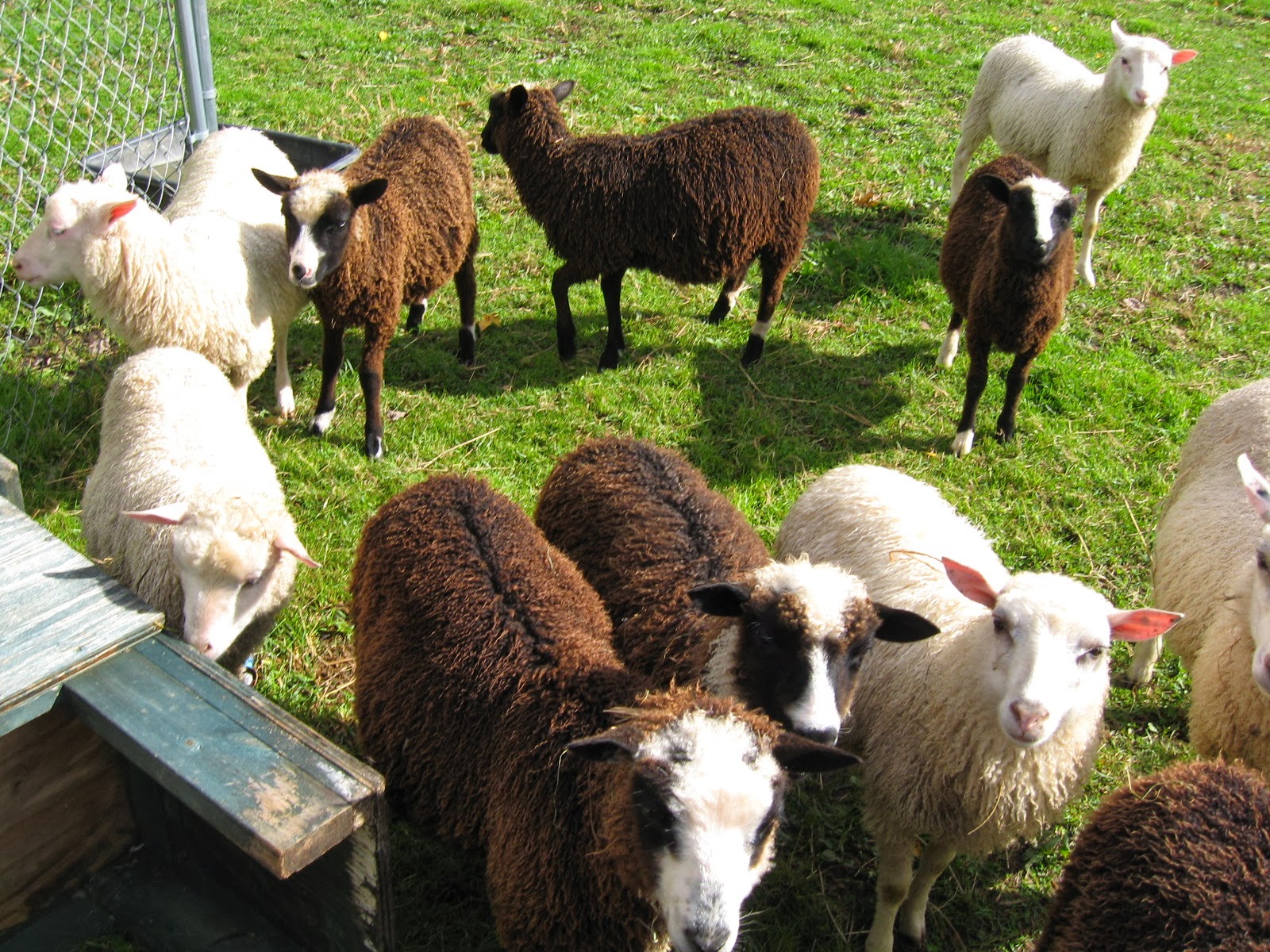
As I stood to take the first photo, I got the groups attention. Then as I continued to photograph, their curiosity overcame them and they started toward me to try to determine what I was up to. Eventually they got bored and resumed their grazing, one by one.

Within the flock are several piebalds. The most striking one is the boy with the black and white face. The other piebalds are more subtle and as their fleeces grow some of them appear to be simple HST's, yet are indeed piebalds.

I find it interesting that out of the piebald lambs we've had here in the last two years, its the ram lambs that display the majority of that trait. I'm not sure if that is coincidental or just my luck so far, but it will be interesting to see how it plays out in the future.

The last two years, we've had grey lambs from the same sire/dam duo, and I love the color and fleece on these lambs. Last year we had one ram lamb with grey, this year a ewe (sold) and a ram lamb. The grey is not the same as the silver or black badger coloring but more of a steely grey color. I definitely intend to keep that in the flock.

I hope you enjoy looking at the boys. They are for sale, and you can direct inquiries through the comments on this blog or to : fossilcreekfarm@yahoo.com

Regards,
Kathryn

Our Breeding Rams

Treble Clef
This is our Finnsheep Ram - Treble Clef

FBA # 24328

Dam: FBA # 22320 Ruby Shoes

Sire: FBA # 22815 Boychick

Clef has been the foundation ram of our flock and contributed a nice big boned body as well as long, wavy, high luster fleece to his offspring.


Freddie
FBA # 23715 Witt VA26-212 aka Freddie

Dam: FBA # 19231 Witt 6522 

Sire: FBA # 23088 Witt VA 26-201

Freddie brings to his progeny a different genetic than Clef and this allows for some diversity in breeding. His offspring  are prolific giving large litters, with  consistent fleece from shoulder to hip.  Freddie is a black " head, socks, tail which he also passes on to some of his lambs.


Asa
 
Asa is new to us this year, coming from Stillmeadow Finnsheep in DeRuyter N.Y.
We feel that Asa will bring diversity of genetics plus a proven bloodline of temperment, fleece quality, size and color to our flock.
Asa's registration is in progress.


Panda is a black piebald who brings spotting genetics to his offspring. Panda is big boned, and quietly tempered making him a pleasure to work around.
Pandas' Dam is:
FBA # 22320 Ruby Shoes
Sire: FBA # 22815 Boychick
 
Panda

Panda is FBA # 2429


Ben
FBA # 25259

Ben is a white ram who carries for black and possibly Badger Grey though we have yet to see that in his lambs. Bred twice to Caden, they have produced both black and white lambs in both litters. Their lambs are striking in their steady growth, correct confirmation, long staple fleeces and large eyes/ears on pretty faces.
Ben is sired by: FBA #23901 Zephyre 
His dam is: Luca FBA # 24518


Wednesday, October 9, 2013

Prolificacy

Registered Finnsheep Ewe - Amelia
This is our 6th year raising sheep and our 3rd year raising Finnsheep exclusively. Amelia, shown in the photo at right, had quads this year after having given triplets last year, twins the year before that and a singleton the year before that.
She and her daughter Caden, born here at Fossil Creek Farm, lambed at exactly the same time and caused this shepherd to be hustling a bit trying to keep up.
Caden had quintuplets, so in a brief period of about 30 minutes, the flock grew by 9.

We've had quads before but quints was a new one for our farm, and this was Caden's second lambing. She had twins last year, so to go from twins to quints was a big leap for her, and I wonder what next lambing season will hold.

Both Caden and Amelia are exceptional dams, caring for their offspring with a devotion that deserves admiration. Attentive, protective and ample supply of milk for their lambs.

One thing about breeding Finnsheep is that you cannot really predict how many lambs will be born from any particular ewe though I make myself crazy at lambing time trying to.
It's a wait and see situation, and for about a month prior to the actual lambing date I start watching the sheep in hopes that they will go early and give me a surprise.

Needless to say, I love lambing time though it is stressful trying to be vigilant, observant and unobtrusive as the girls pass their days waiting, and I anxious and excited try to contain myself until such time as it is obvious there are lambs about to be born.

Sometimes the girls fool my best attempts and manage to have lambs without me, which is both a relief and an insult/disappointment. Finding lambs up and nursing, all dry and happy is pleasing in that I no longer have to agonize over whether things will go well and the lambs will make the first few hours of life without obstacles to overcome.

During lambing time I try not to go anywhere, ANYWHERE ( for days and days ) and make sure I check on sheeple regularly in case they need my help for some reason, and I love being present when the lambs are born as it's much like Christmas, waiting for a package to be unwrapped with the anticipation of what might be inside.

Because Finnsheep can have as many as seven, yes, seven lambs at once, I feel a responsibility to do all I can to be present at lambing time to offer assistance where needed. Personally I am a big fan of not interfering with a natural process, but since these are domestically bred animals, who have been bred to have many lambs, I see my role as protector and facilitator.  And it's in the farms'  best interest to assure a positive outcome for dam and lambs, both financially and in the time invested.

This year we had 30 lambs from 11 ewes with two stillborns that couldn't have been predicted.

I feel this is a successful outcome, and am happy with the lessons I've learned and their application to this years' lambing time.

But what I've come to appreciate is ...no matter how well I managed this year and what valuable lessons I've learned, the outcome is not due to my skill or experience and you can never have enough of either. No where in my life is God more evident than in this little band of creatures I am fortunate to watch over. If the flock prospers, it is more likely in spite of my efforts rather than due to them and what the next lambing season will hold is anyones' guess.

Regards,
Kathryn