Showing posts with label sheep. Show all posts

Friday, January 17, 2014

January 17, 2014


Coyote, Deer, Turkey Habitat
 
Among the worries that plague me as a shepherd, is the concern for predators.


We live in an amazingly rural area, surrounded by thousands of acres of forest. The thrill of this is to witness forms of wildlife the mainstream will never see.

The flip side is that every body has to eat, and the wildlife is no exception.

We have coyotes here, the wolves being removed by DEC decades ago.

Our coyotes however are a hybrid of coyote and wolf cross so they are larger than your average coyote. This isn't just my opinion but scientific fact. Wildlife biologists have actually examined the DNA and determined that at some point the coyotes and wolves intermingled leaving a unique animal as their legacy.

We know there are coyotes, as we have seen them, and certainly have heard them though not lately with the windows closed.

In the seven years we have had sheep, the coyotes have never threatened them so far as I can determine, though they are always nearby.

Other farmers in the area have complained of coyote attacks on their livestock but here we are blessed with coyotes who find their sustenance among the small creatures that abound, and not with our lambs. This allows us to live peaceably enough and truth of the matter is that I personally find the coyotes to be awe inspiring wild things who are mysterious, a bit dangerous and altogether wonderful. I would hate very much to have to resort to hunting them and I am pleased to have lived this long in their presence without complaint.

We have evidence of them being very close to the house and have been awoken in the pre-dawn hours by howling that I would have sworn was just under the bedroom window.

Having discussed their presence and habits with wildlife biologists the advice we received was thus:
If they aren't bothering the livestock then leave them alone. Shooting them opens the way for coyotes from other packs, possibly with experience in killing livestock, to fill the empty place left by having shot a coyote who wasn't a problem.  Rather than allowing that to take place, we have opted to live with the "devil we know" until such time as may be necessary to take action against a coyote or several with a taste for lamb, if ever.

In the scheme of things, I'm more worried about my fellow man being a problem than I am the coyotes.

Regards,
Kathryn

Monday, November 11, 2013

November 11, 2013 Veterns' Day

As a new shepherd one of the things I had to learn was how to care for the flock when things aren't quite right.

Keeping the flock healthy isn't very hard, but when an unusual medical situation crops up unexpectedly, you either handle it yourself, or call your vet.

There are two main reasons to reserve calling the vet, one is distance. Our livestock vet is an hour away, and since they schedule rounds for most days, they aren't  immediately available to drop what they are doing and drive an hour to my farm. This is a consideration before I pick up the phone.

The other is cost. A farm call is $75.00 and this just covers their coming on the property, no treatment. Weighing both of those things against the need is always a consideration.

In the early days of our shepherding, things went well for the most part. The first call for our vet was to draw blood on the sheep for Johnnes and OPP as a matter of routine. Though some people do this themselves and send to an independent lab, I'm squeamish and would rather the vet do it, quickly, efficiently and easily.

This initial visit allowed us to ask questions and meet the vet prior to any emergency that might arise later on. We didn't want our first contact to be a cold call.

Over time our relationship has grown to a point of trust and co-operation and I feel very strongly that our livestock vet truly has the best interest of the animal at heart.

We have an option for saving the on-farm call fee, by transporting the animal to the vets' office, and we've done this on several occasions. Each time it has been for a lamb, so transport was easy as was the office call. This is a good option.

We have also sought advice via phone call, and have requested certain medications via email, which have been mailed out without problems.

We can give injections, treat wounds, administer oral medications, cast limbs, handle some obstetric situations up to this point,  (God I'm not asking to be challenged here :-) ). Our vet has responded to my request for additional knowledge of certain illnesses with detailed emails on how to perform invasive procedures when there is no other option. Not the best solution but if it is that or death, I'd just as soon pull out all the stops and try to save my animal.

This past spring we had a case of what I believe was bloat in which, despite my efforts and a call to the vet, we lost the animal anyway.  Sometimes it happens and you remember that the other side of life is inevitable death for all of us someday.

The highest priority for an animal that is ill in our flock is to reduce the amount of suffering they may be experiencing. Sometimes this means death and its not easy when you have invested much in bringing the animal as far as it has already come.

All in all, for six years now, we've done okay in terms of emergencies and unforeseen complications, having cared for just about 80 sheep in this time period.

What I've learned is to stay humble, watchful and always ready to learn.

Regards,
Kathryn


In Memory of Mary ScholefieldFriend, fellow shepherd and teacher. You taught me so much!
Rest in peace dear friend.

January 19, 1960  - November 12, 2011


Sunday, November 10, 2013

More Lambs for Sale

Available until November 13, 2013. We are happy to accept a deposit to hold your lamb, arrange for board until you can pick it up, and accept Paypal!


Flash
Demi FBA # 26536
Panda FBA # 24239
Flash is a piebald and carries for spotting. He is a triplet with excellent bloodlines and a soft, crimpy fleece.


Demi just prior to lambing triplets 2013


Flash at Five Months


Panda - Sire of Flash
 

Monday, November 4, 2013

November 4, 2013

 Breeding season is upon us.

Finnsheep can breed all year long, but many people, myself included, prefer spring lambs, so breeding is timed for fall.  November breeding will bring April lambs. Depending on the year, maybe a bit late for Easter, but otherwise in time for the lush new grass and a good time for the lambs and ewes who are lactating.

A common practice with sheep is to "flush" them prior to breeding. This means they are offered the best possible nutrition in grain, supplements and hay that is available. The theory is that nature will recognize a well fed and well nourished animal and conditions will encourage multiple lambs because of it.

In some towns throughout the U.S and one on Long Island that I have first hand knowledge of, the name FLUSHING MEADOWS crops up, and even Queens has a borough known as FLUSHING, though the part about the meadow is absent, perhaps having been dropped over the years.

This refers to an area once designated for the purpose of putting animals out on pasture, flushing them with the nutrients available on the new grass. Who knew? And how interesting to envision Long Island and Queens as the once rural, agricultural areas we know them to have been.

Finnsheep however, are able to have litters of as many as 7 lambs at once, with litters of four and five fairly common. Due to this I personally do not flush the ewes prior to putting them with the ram.

Last year we had 30 lambs from 11 ewes. One singleton, two sets of twins, one set of quintuplets and one set of quadruplets, all the rest were triplets.

The single lamb was born to a first time dam.


Of the lambs offered for sale are two remaining ewe lambs that are from a quintuplet litter.

These lambs were sired by Ben. Caden is the dam.   Cadens' dam gave quadruplets this year. 

This was Cadens' second lambing, having produced twins last year. The lineage is one proven for large framed, prolific progeny with outstanding maternalism, hand spinning fleeces and docile temperaments. 

No flushing necessary!

Regards,
Kathryn


Wednesday, October 30, 2013

Octobe 30, 2013

Luca   FBA #  24518


Up and at 'em on this wet, overcast, raw day!

Today will be a big day as we learn from our first experience with the livestock auction house.

We'll be loading up a mix of the ram lambs and teenaged rams and saying goodbye to them today.

This will give us some breathing room, though we expect to take another load in two weeks; then we should have the flock down to a manageable size for winter.

Awaiting pick-up are two ewes that will be exposed to our new ram, Asa and sold bred, and two ewe lambs and a ram lamb that will be going to fiber homes, with potential for breeding next year. They will be picked up on Friday.

I am holding back a few of the nicest ( hard call, they are all nice ) ram lambs and all of the ewe lambs in hopes of selling them to individuals before the next auction sale.

Already planning breeding groups, and after six years, the flock is going through some major adjustments this year in terms of replacement ewes, and starting new and separate bloodlines.

I have been reviewing flock goals and specific breeding animals to see if they fit in with those goals, and making adjustments accordingly, but sometimes it hurts my brain.

What I've learned is this...its just as easy to have lovely fiber animals, and companions with outstanding genetics as it is to have lesser quality fiber animals/companions. Not that any going to auction have anything to be ashamed of, they are all quite lovely. But from here on 
with a very critical eye to producing the best of the best, my fiber pets will need to be top quality to stay in the flock.

I look forward to reporting on how it unfolds at the auction house.

Regards,
Kathryn

Sunday, October 27, 2013

Using Our Wool

As a weaver who likes to use my own wool, I have run into a few glitches with supply.


The loom takes alot of yarn to operate. A 2 ft x 3 ft rug or a 40 x 60 throw blanket will use as much as five pounds to complete the textile.

When I first started spinning and weaving I did it all by hand, myself and gained experience along with many fruitful hours creating threads.

But once I had my own flock I realized that time was more of an issue and best spent tending the critters, so I opted to send my fleeces to a mill. This turned out to be a great decision for a variety of reasons.

The mill I use - Dreamweaver Creations in Sherburne, N.Y., is located a mere 17 miles from my home affording me the opportunity to just load up my truck and make a trek over. Once there I have the gift of being able to talk with mill owner Heather Lathrop about my plans, the fleeces I've brought and what I want the end result to be. Often she will show me something from another customer or her own fiber ( she raises Blue Faced Leicesters ) that may convince me to alter my plans somewhat. This face - to - face time is invaluable.

Our flock usually hovers around 15 animals give or take, which provide about 75 lbs of fleece after skirting. During processing I might lose 8 lbs of that leaving me with 68 lbs. Turning that 68 lbs into a 2 ply yarn gives me just enough for 13 projects. Not really as much as I'd like but overwintering more sheep isn't feasible either.

I have gone outside the Finn breed to local shepherds who aren't using their wool and arranged to purchase from them, incorporating that resource into a variety of projects and saving the Finn wool for special items only.
In this way I've had felt, roving and batts made from organically raised Clun Forest sheep nearby, lovely yarns and rovings from Border Cheviot sheep raised in proximity of the fiber mill, and a host of other breeds and types including alpaca and mohair.

Ideally I'd love to arrange to purchase unused good Finn wool from other shepherds, and utilize more of it in my special projects but most Finn shepherds use their own wool and the supply is limited so I work with what I have. Perhaps one day I'll be able to arrange to purchase unused Finn wool from other shepherds and expand my supply for hand woven items from my loom. Till then,

Regards,
Kathryn


Organic felt sheets and batts
 

Detail of commissioned saddle blanket


Detail of Wool Rug
 
 
Reproducing 19th Century Venetian Carpet
 
Throw Blanket in Progress


     Hand spinning organic roving


 Handspun Organic Chunky Yarn
 
 
Thick and Think Finn - Mohair blend
 

100% pure Finn Thick and Thin

Tuesday, October 22, 2013

Shearing

My favorite winter ensemble. Carharts', flannel and sheep!
When I considered one day becoming a shepherd, I knew that I would shear my own sheep. Something about the gritty, skilled labor was appealing.
Sheep shearing is very physical and exhausting, perfect ground for developing all manner of injuries from repetitive motions and spending so much time bent fully over in a position that at first, I didn't think was humanly possible.
 
There are many ways to shear a sheep and many types of equipment.
 
But there is only one right way to do the job.
 
Cornell Shearing School was instrumental in providing much of the hands-on supervised instruction that is a confidence builder, and I enjoyed the first weekend session so much that I attended again the following year.
 
During the two day course, we learned about caring for and setting up our equipment, how to catch and rump a sheep ( set it on its butt ) and most importantly, how to hold said sheep with your legs while your two hands are completely involved in the shearing process. This technique takes some getting used to and relies on both the shearers' position and taking advantage of the animals own weight and natural instincts.
 
There is a pattern to follow in shearing a sheep, endorsed by the New Zealand Wool Board, and originally developed by Godfrey Bowen.
 
It took me 100 sheep before I felt like I could begin to tackle the animal from memory of the shearing pattern. For many shearings, I kept my pages of instructions within reach, often stopping to refer to them for the next step.
 
The main reason for shearing is to obtain the valuable wool, but there are health considerations that necessitate shearing as well. One of these is the incidence of "fly strike" where the wool around the tail area becomes laden with feces. During warm months flies lay eggs that hatch into larvae and proceed to eat the flesh of the sheep. In worst cases the sheep can die. This is easily avoided by shearing in a timely fashion. Usually once a year, in the spring.
 
Fleeces differ in size depending on the sheep breed, and can range from 2 - 4 pounds from a Shetland or Baby Doll Southdown, to 12 - 14 pounds for a Merino, Hampshire or Corriedale.
 
Because of the rigorous nature of shearing, many people take a different approach and use everything from kitchen Fiskars, to small hand held dog clippers trimming and shearing while the sheep stands on its feet, usually contentedly munching on hay.
 
While this process can take longer it is much kinder to the person doing the shearing and depending on the nature of the sheep, can be enjoyable for it too.
 
In my experience, ( at this time I've shorn 500 + sheep, not a lot but enough to have an educated opinion about the process ) I think it is vitally important to clean the belly and underside of the sheep. This is best done when access and the ability to clearly see the area is achieved while the sheep is on its butt. From that position the rest of the shearing process is a natural progression of movements, much like a dance, that allows the shearer to stay balanced, minimize exertion, keep the sheep relaxed and facilitate getting the fleece off often in one piece, making it much easier to skirt.
 
It takes me just about 12 minutes to remove a fleece. In the 365 days of the year, one 12 minute session isn't a big deal for the sheep, leaves them cool, clean and lighter, and allows me to get on with the rest of the flock in a speedy manner. Then I can dive into all that glorious raw fleece!
 
 
Doug can remove an entire fleece in five minutes or less - so, while the sheep may look uncomfortable, it only stays in one position for about 20 - 40 seconds before it is moved into a different position.  The process allows the sheep to be totally relaxed.  If it struggles then the shearer repositions until it is comfortable. Can't shear a struggling sheep!
 
 
Dough Rathke
Internationally acclaimed, award winning sheep shearer and instructor.


Sunday, October 13, 2013

Ram Aggression

When we began our shepherding journey, our very first Finnsheep was Treble Clef - the boy on the right. He came to us at about six months of age.


Brothers Panda and Treble Clef
I was struck by his friendly nature and wanted a sheep in the worst way, so a deal was made and this fledgling shepherd brought home the first ram, and first Finnsheep.

Although I had heard many times, never to trust a ram or turn your back, my experience with young Clef was such that aggression on his part was non-existent and our blissfully happy relationship continued this way for more than a year. As one might imagine, I forgot all the dire warnings I'd heard, and came and went from the sheep pasture with ne'er a thought as to consequences.....until....one day.

 During routine chores I entered into the sheep enclosure ( by this time the ewes were also in with Clef as it was breeding season ) and proceeded about the task of picking up the rubber feed dishes without regard for where Clef happened to be in the pasture.

Suddenly, rudely and without warning, my beloved ram and friend, charged me full on and connected in a rather painful butt. Stunned by the unexpectedness of it, I stood dumbfounded as he came at me again, and again. My first reaction was to clock his head, which was merely an invite to continue, not a good choice (I later reasoned). Eventually it occurred to me to rump him, set him on his butt much like one does when shearing, to show dominance. This finally convinced him I was the boss, and after a bit of humiliation on his part, I let him up and he walked away without further incident.

I'd like to say that was the last of it, but that would be untrue. A handful more times over the next two or three years he tried it again but I had found the key, and immediately rumped him which invariably ended the session.

We've been shepherding partners now for six years and our relationship is a good one. We respect each other and enjoy spending time together for those scratches, rubs and invariable kisses. He has been my foundation ram leaving many progeny which show no signs of the same behavior.

I've learned that breeding season brings a whole new level of behaviors which I can anticipate and also, never to turn my back on any of the boys regardless of time of year. They seem to think of me as their ewe and competition for my attention can sometimes cause a bit of pushing and shoving which I watch out for.

My yearling ram boys have never, ever made an attempt to do such a thing even at breeding season and I have no reason why that is true. But I still keep an eye out when I'm in with them just to be on the safe side.

While many people feel strongly that a ram's act of aggression toward the shepherd should be met with a visit to the slaughter house, my perspective is that I don't want to eliminate all tendency toward aggression because I don't want to end up with a sheep that doesn't have the instinct to protect itself or its offspring. This may be a loose connection but I've read of other breeds where this became an issue, and so its always stayed in the back of my mind.

Had I eliminated Clef after the first aggression, I would have missed out on some very nice lambs and the opportunity to see where this experiment in sheep behavior would end up. Fortunately for us and our farm, its ended up well.

Whatever your thoughts are on ram aggression, or your experiences are, you must do what you believe to be in the best interest of your flock and farm. I am not suggesting that all rams be allowed to confront and be aggressive toward their shepherd by any stretch. I am simply offering my experience as food for thought.


Regards,
Kathryn


Thursday, October 10, 2013

Ram lambs from 2013


All of these ram lambs have been sired by the adult rams on the Ram page. Many have been sired by Freddie. Our white ram BEN isn't yet listed on the ram page as I haven't gotten a good photo of him yet, but he has produced nicely built, exceptional ewe and ram lambs over the past two years, including the quintuplets born to Caden this June. Pic coming shortly.

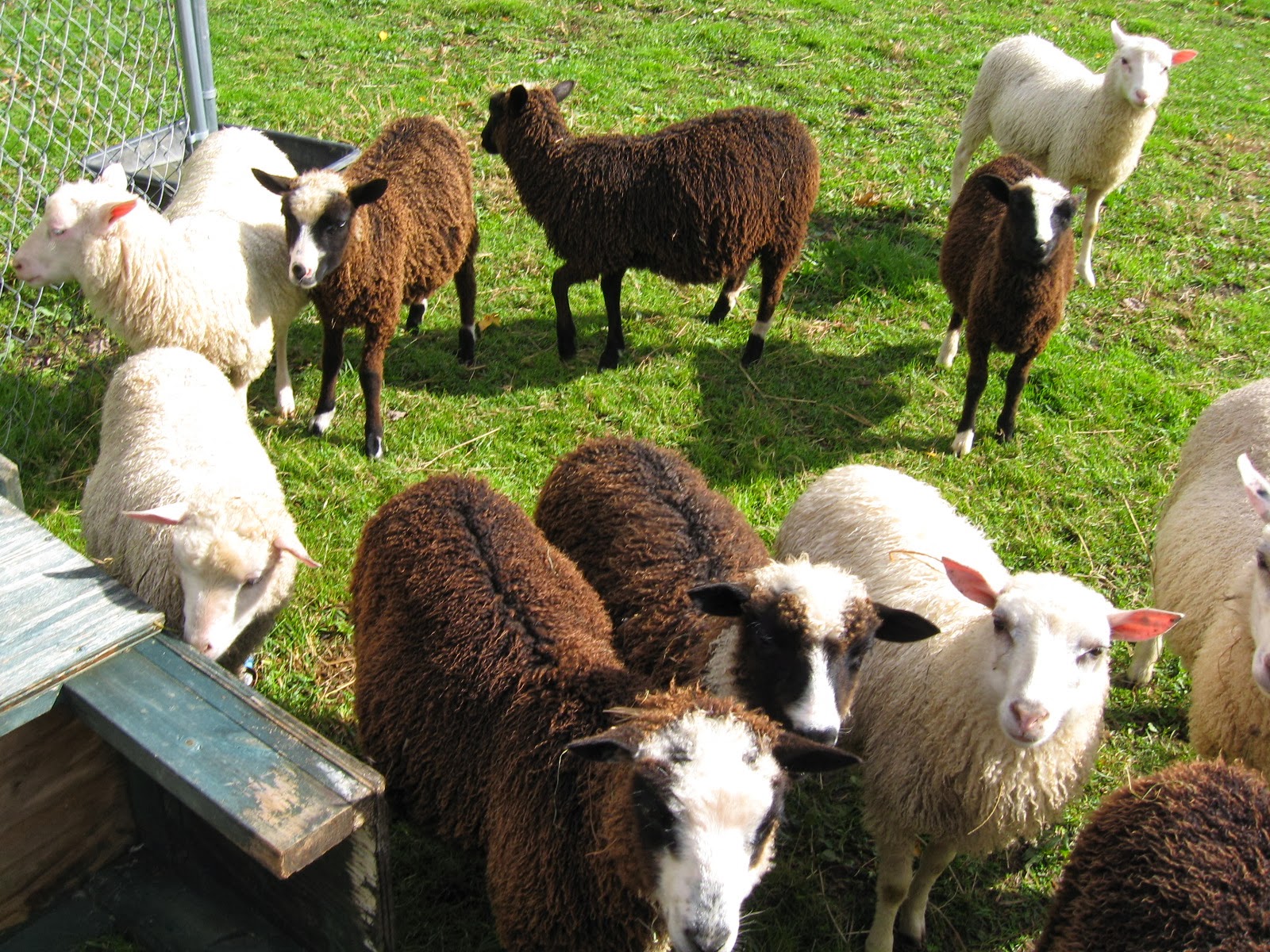
As I stood to take the first photo, I got the groups attention. Then as I continued to photograph, their curiosity overcame them and they started toward me to try to determine what I was up to. Eventually they got bored and resumed their grazing, one by one.

Within the flock are several piebalds. The most striking one is the boy with the black and white face. The other piebalds are more subtle and as their fleeces grow some of them appear to be simple HST's, yet are indeed piebalds.

I find it interesting that out of the piebald lambs we've had here in the last two years, its the ram lambs that display the majority of that trait. I'm not sure if that is coincidental or just my luck so far, but it will be interesting to see how it plays out in the future.

The last two years, we've had grey lambs from the same sire/dam duo, and I love the color and fleece on these lambs. Last year we had one ram lamb with grey, this year a ewe (sold) and a ram lamb. The grey is not the same as the silver or black badger coloring but more of a steely grey color. I definitely intend to keep that in the flock.

I hope you enjoy looking at the boys. They are for sale, and you can direct inquiries through the comments on this blog or to : fossilcreekfarm@yahoo.com

Regards,
Kathryn